
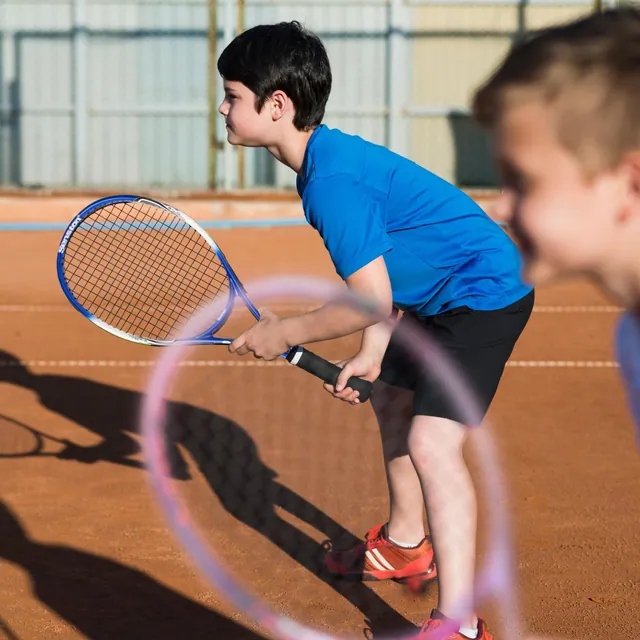
- Age 8 and under
- 19, 21 or 23 in
- Ages 9 and 10
- 23 or 25 in
- Moving to the 78-foot court
- 26 in
- Adults
- 27 in
How long should a tennis racket be for my child?
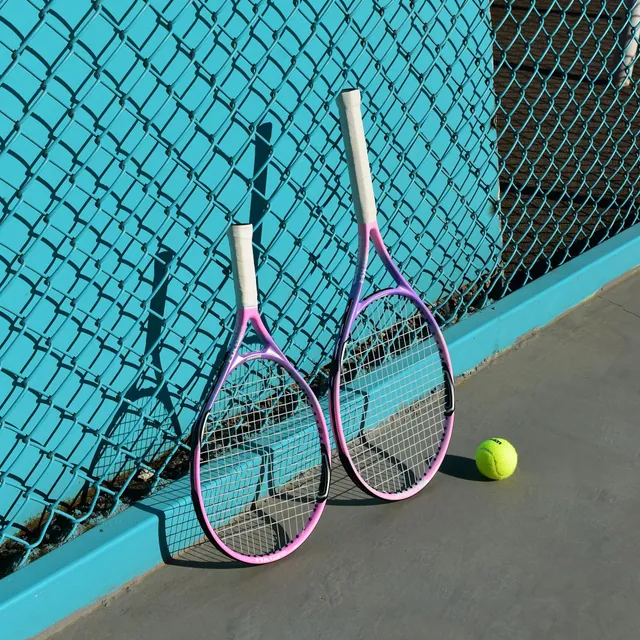
Most kids age 8 and under play with a 19, 21 or 23-inch racket, and most 9 and 10-year-olds play with 23 or 25 inches. Our Kids Tennis Racket comes in 17, 19, 23 and 25 inches, so you can match your child’s band now and move up next year.
Length matters more than color, weight or the picture on the strings. A racket that is too long drags the head into the ground, pulls the wrist down and turns every swing into a fight. A racket that is too short makes your kid reach for balls that a longer frame would meet. The United States Tennis Association puts it plainly:
“The most important part, particularly when selecting a racquet for a child, is to choose one that’s sized right.”
USTA, Pick the Right Racquet
USTA groups junior rackets by length and by age. The youngest band gets three lengths, because kids of 5 and kids of 8 are not the same size, and the 23-inch length sits in two bands at once. Here is the short version, in the words USTA uses:
“These are all generally youth racquets for players age 8 and under.”
USTA, Pick the Right Racquet, on 19, 21 and 23-inch racquets
| Racket length | Who it is for, per USTA |
|---|---|
| 19, 21 and 23 in | Youth players age 8 and under |
| 23 and 25 in | The 9 to 10-year-old age group |
| 26 in | Youngsters moving to the 78-foot court |
| 27 in and up | Players of all ages and levels on a 78-foot court |
You will notice that the bands overlap. A tall 8-year-old and a small 10-year-old can both hold a 23-inch racket well. That is why the age is a starting point and the child in front of you has the final word. A quick home test settles most of these in-between cases in under a minute.
The 26-inch length is a step of its own. USTA describes it as the racket for kids who are leaving the smaller junior courts behind:
“This is a great racquet for youngsters looking to make the transition to the 78-foot court.”
USTA, Pick the Right Racquet, on 26-inch racquets
We do not make a 26-inch racket. Our kids line stops at 25 inches and our adult line starts at 27 inches. If your child is in that gap, the home test will tell you which side they lean toward. Many kids go straight from 25 to 27 when they start to play on the 78-foot court.
How do you check the racket size at home?
Let your child hold the racket at their side with the head pointing down. If the head stops just above the floor without touching it, the length is right, and the test works the same for a 17-inch racket as for a 27-inch one.
USTA describes the same check:
“A simple way to know if a racquet is the correct size for you is to hold it by your side with the head pointing down toward the ground; the racquet head should be just above the floor but not actually touching the ground.”
USTA, Pick the Right Racquet
Here is how to run it so the answer is fair:
- Ask your child to stand up straight and relax the shoulder. Kids like to hunch or lift the arm to “win” the test.
- Hold the racket by the end of the handle, the way they will hold it on court, not halfway up.
- Look from the side. If the head scrapes the floor, the racket is too long. If there is a gap of a hand or more, it is likely too short.
- If you are between two lengths, try the arm-down test with both, then let your kid swing each one a few times.
Tip: Run the test in the shoes your child wears to play, not in socks or slippers. A thick sole changes the gap under the racket head.
You can run the same test in a store, at a friend’s house or with a racket borrowed from a coach. No tape measure, no math. The test also works for adults, and that is a nice way to see why the 27-inch frame fits most grown players.
Getting the length right is not only about comfort. USTA ties it to how a young player learns to hit:
“Using the right-sized racquet is important to the development of a player’s fundamentals.”
USTA, Pick the Right Racquet

Kids grow fast, and it is tempting to buy a long racket so it lasts. We understand the thought. But a racket that is two sizes too big will make the first year of lessons harder, and a frustrated kid tends to quit before they grow into anything.
Tip: Buy the length that fits today, not the one your child will grow into. A shorter racket handed down to a younger sibling is never wasted.
Which Senston kids racket fits which age?
Our 19-inch and 23-inch kids rackets sit inside the USTA band for players 8 and under, and our 25-inch racket sits in the 9 to 10 band. The 17-inch racket is shorter than anything on the USTA list, and we size it for the smallest beginners, ages 3 to 5.
The Kids Tennis Racket is our main junior frame. It is aluminum, molded in one piece, and every one of them comes with a cover, an overgrip and a vibration dampener. Colors depend on the length:
- 17 inches: purple
- 19 inches: blue or pink
- 23 inches: red, white, pink, blue or purple
- 25 inches: pink, red or blue
The 23-inch length in numbers:
- Length
- 23 in
- Weight
- About 210 g unstrung
- Head
- 92 sq in
- Grip
- 4 1/4 in
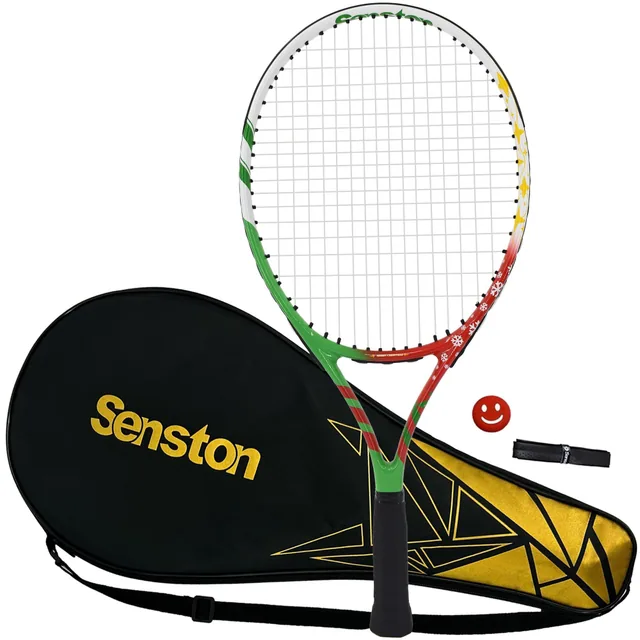
Senston Kids Tennis Racket, 17 to 25 Inch
The 17, 19, 23 and 25-inch lengths line up with the USTA bands, and each racket comes with its own cover, overgrip and dampener.
Then there is the lion one. The Kids Tennis Racket with Lion Print comes in pink, in 17 or 23 inches. We size the 17-inch for ages 3 to 5 and the 23-inch for ages 6 to 8.
It is also aluminum, and it comes in a carry bag with an overgrip and a dampener. It is a good first racket for a preschooler who wants a lion on it more than they want a forehand. Kids over 9 usually move up to 25 inches, so it is not the one for them.

Senston Kids Tennis Racket with Lion Print, 17 or 23 Inch
A 17-inch racket for ages 3 to 5 or a 23-inch one for ages 6 to 8, with a lion print that small kids like to carry around.
| Racket | Length | Who we size it for | In the box |
|---|---|---|---|
| Kids Tennis Racket | 17 in | The youngest beginners | Racket, cover, overgrip, dampener |
| Kids Tennis Racket | 19 in | Ages 8 and under (USTA band) | Racket, cover, overgrip, dampener |
| Kids Tennis Racket | 23 in | Ages 8 and under or 9 to 10 (USTA lists 23 in both), about 210 g unstrung | Racket, cover, overgrip, dampener |
| Kids Tennis Racket | 25 in | Ages 9 to 10 (USTA band) | Racket, cover, overgrip, dampener |
| Kids Tennis Racket with Lion Print | 17 in | Ages 3 to 5 | Racket, carry bag, overgrip, dampener |
| Kids Tennis Racket with Lion Print | 23 in | Ages 6 to 8 | Racket, carry bag, overgrip, dampener |
What do parents tell us? Most of the comments are about the weight and the bag. Kids find the rackets light and easy to carry.
The weak spot is the handle wrap that comes on the frame. One parent wrote: “After 2 uses (1 hour each) the grip began to unravel.” Another said the case and the base of the racket broke within a week at a tennis camp. We want you to hear that from us.
Tip: If your kid plays every day at camp, put the spare overgrip on in the first week, and keep the racket out of the bottom of a heavy sports bag.
These are rackets for learning the game, not for junior tournaments. If your child already trains several times a week with a coach, ask the coach what they want in a frame. The coach sees your kid swing and we do not.

When should a child move up to a 27-inch racket?
Move up to 27 inches when your child starts to play on the 78-foot court and the arm-down test shows the 25-inch racket is clearly short. USTA does not see 27 inches as an adult-only length:
“there are now 27-inch racquets that are a great fit for players of all ages and levels playing on a 78-foot court.”
USTA, Pick the Right Racquet, on 27-inch racquets
For most families that means the 25-inch racket covers the 9 and 10-year-old years, and the jump to 27 inches comes when lessons move to the 78-foot court. Some kids spend a season on a 26-inch frame in between. We do not make one, so if your coach wants that step, buy a 26 from another brand and come back for the 27.
Our 27-inch rackets are not light junior frames. They are heavier than the 23-inch kids racket:
- Kids racket, 23 in
- About 210 g unstrung
- Adult racket, 27 in
- 260 to 280 g unstrung
A strong 11 or 12-year-old will handle that well. A small one may get tired by the end of a long lesson. If your kid’s swing slows down halfway through a practice, give them a few more months on the 25.
What should an adult beginner look for in a racket?
An adult beginner does well with a 27-inch racket and a mid-plus head of 96 to 100 square inches. Our Adult Tennis Racket, 27 Inch has both, weighs 260 to 280 grams unstrung and has a size 2 grip, which is 4 1/4 inches.
Why 27 inches? It is the length most adult rackets have, and the arm-down test tells most grown players that it fits. USTA points out that you can go longer, but there is a trade:
“There are also some racquets available at 27.5, 28 and even 29 inches, with the longer racquets generally providing more power but less control.”
USTA, Pick the Right Racquet
When you are learning, control is what you want. You are still finding the middle of the strings, and a longer frame makes that harder.
A head of 96 to 100 square inches gives you a bit more room to miss, and it is still small enough to aim. Our adult frame is aluminum alloy. It comes in blue, purple or white-pink, with a cover, an overgrip and a dampener in the box.
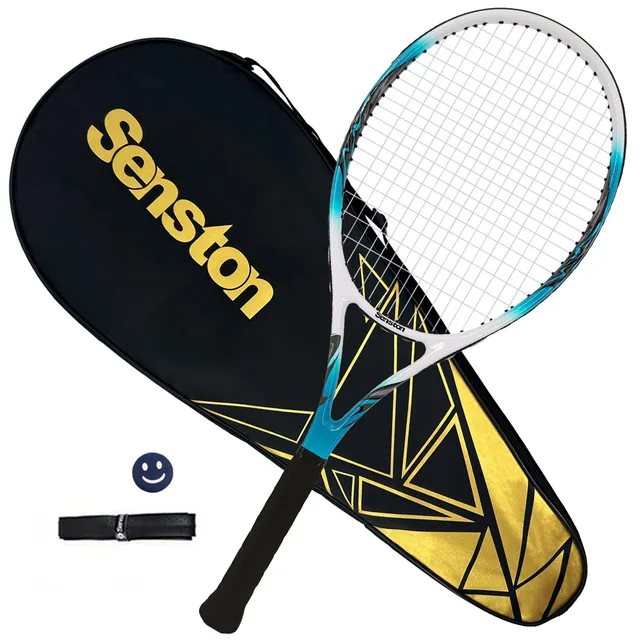
Senston Adult Tennis Racket, 27 Inch
A 27-inch aluminum racket with a 96 to 100 square inch head and a 4 1/4 inch grip, made for adults who play for fun or are starting lessons.
- Length
- 27 in
- Weight
- 260 to 280 g unstrung
- Head
- 96 to 100 sq in
- Grip
- Size 2, 4 1/4 in
If two of you are starting together, look at the Adult Tennis Racket Set for 2 Players. You get two 27-inch rackets, a shoulder bag, three balls, two overgrips and two dampeners. That is everything you need to walk to the park courts and hit. The pairs come in pink and blue, purple and pink, red and blue, or two black rackets.
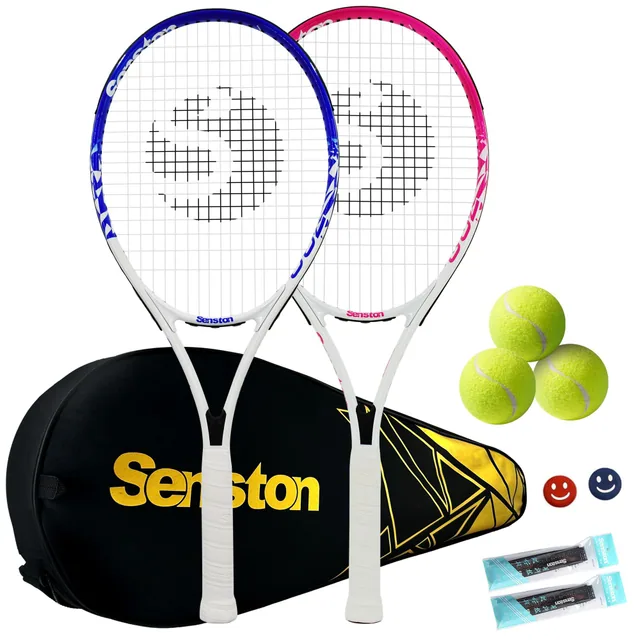
Senston Adult Tennis Racket Set for 2 Players
Two 27-inch rackets with a shoulder bag, three balls, two overgrips and two dampeners, for a couple or two friends starting at the same time.
The same 27-inch racket also comes in our 27-Inch Tennis Racket Kits. Choose two rackets with a case and two overgrips, one racket with five overgrips, or one racket with a cover, an overgrip and a dampener. Pick the kit by the extras you want. If you know you sweat a lot, the five spare overgrips will get used.
| Product | Rackets | Cover or bag | Overgrips | Dampeners | Balls |
|---|---|---|---|---|---|
| Kids Tennis Racket | 1 | Cover | 1 | 1 | 0 |
| Kids Tennis Racket with Lion Print | 1 | Carry bag | 1 | 1 | 0 |
| Adult Tennis Racket, 27 Inch | 1 | Cover | 1 | 1 | 0 |
| Adult Tennis Racket Set for 2 Players | 2 | Shoulder bag | 2 | 2 | 3 |
| Kit: 2 rackets + case + 2 overgrips | 2 | Case | 2 | 0 | 0 |
| Kit: 1 racket + 5 overgrips | 1 | No cover | 5 | 0 | 0 |
| Kit: 1 racket + cover + overgrip + dampener | 1 | Cover | 1 | 1 | 0 |
Adults who bought the set tell us the rackets are light and easy to swing. The complaint we hear most is about the handle wrap again. One buyer wrote: “The grip immediately started falling off after one use.” That is fair to raise, and it is why the set comes with spare overgrips.
Tip: Wrap one of the spare overgrips on before your first session. The wrap that comes on the handle stays protected underneath and lasts longer.

What grip size do I need, and what if 4 1/4 inches is too small?
Our adult rackets have a size 2 grip, which is 4 1/4 inches, and our main kids racket has a 4 1/4 inch grip too. If the handle feels thin in your hand, an overgrip adds a thin layer, and two layers add a little more.
- Adult grip
- Size 2, 4 1/4 in
- Kids grip
- 4 1/4 in
- Keel overgrip
- 0.03 in thick
- Grip tape
- 0.6 mm thick
Grip size is the distance around the handle. A handle that is too thin makes you squeeze hard to stop the racket turning in your hand, and a tight squeeze tires the forearm. A handle that is too thick makes it hard to change grips between forehand and backhand. You want a handle you can hold firmly without clenching.
Here is how an overgrip changes things. Our Perforated Overgrips with Keel are 0.03 inch thick. Our grip tapes in the 2 pack and the 3 packs are 0.6 mm PU. One layer of either makes the handle feel a touch fuller, but it will not turn a 4 1/4 inch handle into a much bigger one.
Tip: If your hand is large and you already play with a bigger grip, buy a racket with that grip size from the start. A stack of overgrips feels soft and lumpy.
Our rackets are not made in bigger grip sizes.
For kids the question goes the other way. A 4 1/4 inch handle is already a full handle for a small hand. Do not add a second overgrip on top of the one that comes with the racket. If your child’s fingers barely reach around the handle, keep it to one thin wrap.
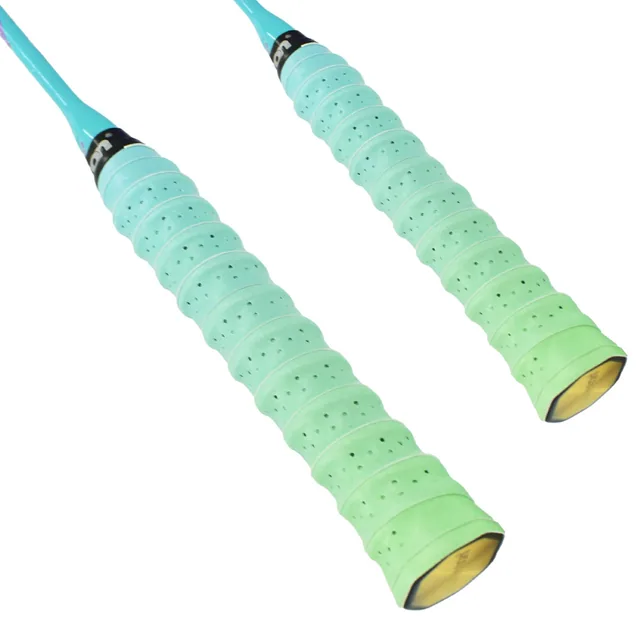
Senston Racket Grip Tape, 2 Pack
Two 0.6 mm PU grip tapes, flat or keeled, so you can try how a fuller handle feels before you buy a bigger pack.

Bat tape is a different product. Our baseball and softball bat tape is 1.1 mm PU, almost twice as thick as our 0.6 mm racket tapes, so keep it on the bat. On a racket handle, a 0.6 mm overgrip feels thinner and closer to the frame.
What is the difference between keel, flat and vented overgrips?
A keel overgrip has a raised ridge down the middle, a flat one is smooth, and a vented one has holes to let air through. Our Perforated Overgrips come in keel and flat versions, 43.3 by 1 inch, five to a pack.
| Overgrip | Surface | Thickness | In the pack |
|---|---|---|---|
| Perforated Overgrips with Keel | Keel or flat, perforated, 43.3 × 1 in | 0.03 in | 5 |
| Black Keel Overgrips | PU, EVA keel, hexagon pattern, 43.3 × 1 in | 0.03 in | 3 |
| Vented Overgrips | Vent holes, raised edge, 1130 × 25 mm | 1 mm | 5 |
| Racket Grip Tape, 2 Pack | PU, flat or keeled | 0.6 mm | 2 |
| Racket Grip Tape, 3 Pack | PU, one solid color | 0.6 mm | 3 |
| Tennis Overgrip, 3 Pack | PU, mixed or single color | 0.6 mm | 3 |
The keel gives your fingers something to feel. When you wrap it, the ridge spirals around the handle, and each finger sits against an edge.
Players who like it say the racket turns less in the hand. One buyer wrote: “Unique raised ridges are easy to get used to.” Players who do not like it feel the ridge as a bump. If that sounds like you, pick the flat version.
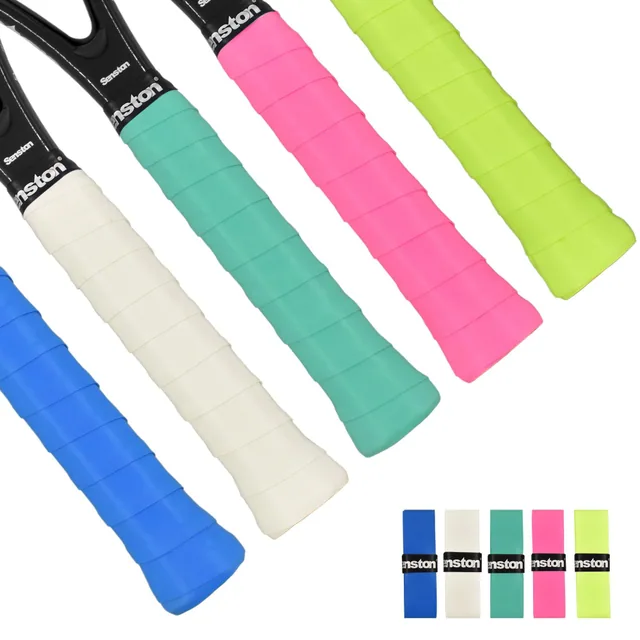
Senston Perforated Overgrips with Keel, 5 Pack
Our most-rated grip: perforated keel or flat overgrips, 43.3 by 1 inch and 0.03 inch thick, five to a pack.
If you want the same keel in one color, our Black Keel Overgrips are PU with an EVA keel and a hexagon pattern pressed into the surface, three to a pack. They fit tennis, badminton, squash and pickleball handles, so one pack can go around the house.
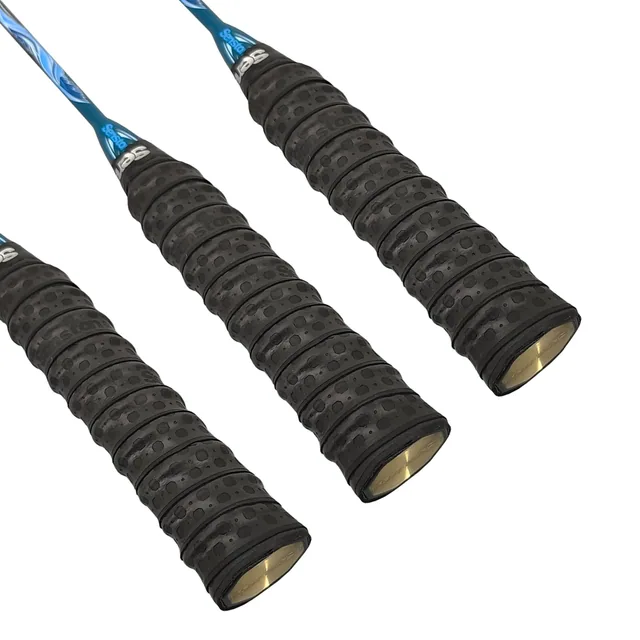
Senston Black Keel Overgrips, 3 Pack
Three black PU overgrips with a raised EVA keel, for a player who wants every racket to look the same.
Vented overgrips are for hot days. Our Vented Overgrips have vent holes and a raised edge, and they measure 1130 by 25 millimeters and 1 millimeter thick. That makes them the thickest of our racket grips. If you like a thin feel, stay with the 0.6 mm tapes.
Tip: Change an overgrip when the surface turns slick or shiny. Overgrips are made to be replaced, and that is why they come in packs.
Two honest notes from buyers. Some players with big handles find the 43.3-inch length tight. One wrote: “It’s disappointing that its too short”. If your handle is long, start the wrap with less overlap.
Another buyer wrote that “if using with sweaty palms it does not wick moisture well”. No overgrip stays dry forever, and a sweaty summer will wear one out faster.
How do you wrap an overgrip?
A 43.3-inch overgrip takes about 5 minutes to wrap the first time and 2 minutes after that. You start at the bottom of the handle, wind up toward the head with an even overlap, and tape the end down.
| Step | What to do | What to watch |
|---|---|---|
| 1 | Take off the old overgrip. Leave the base grip in place. | Wipe a sticky base grip with a dry cloth. |
| 2 | Peel the backing strip off the new overgrip. | Start with the tapered end. |
| 3 | Put the tapered end on the bevel at the butt cap and hold it with your thumb. | The taper should lie flat on the bevel. |
| 4 | Turn the racket with one hand and feed the overgrip with the other. | Pull just enough that it stretches a little. |
| 5 | Overlap each turn on the one before by the same amount. | Most players overlap about a third of the width. |
| 6 | On a keel overgrip, follow the ridge up the handle. | One clean spiral line, no wandering. |
| 7 | Stop where the handle meets the throat and cut the extra at an angle. | The cut end should lie flat. |
| 8 | Tape the end down with finishing tape. | Press it smooth all the way round. |
A loose wrap slides around the handle, and a wrap pulled too hard thins out and tears. Aim for the middle. If you have a keel overgrip, keep your eye on the ridge. It tells you right away if the spiral starts to drift.
Your first wrap may come out uneven, and that is fine. Unwind it and try again. The overgrip will take a second try. One buyer of our grip tape said it was “easier than I thought”, and most people find the same after one go.
Tip: Right-handed and left-handed players often wrap in opposite directions. Hold the racket in your normal grip and run your hand down it. If the edges push against your skin, rewrap the other way.
Do vibration dampeners actually help?
A dampener reduces string vibration and changes the “ping” you hear, and that is all it does. Our Smile Face Vibration Dampeners come 6 to a pack, and every Senston racket already has one in the box.
The dampener is a small piece of silicone. If yours gets lost, or if your kid wants a new one, our pack has six in red, blue and yellow. Put one in the strings near the bottom of the head, between the two middle strings, below the area where you hit the ball.
Tip: Kids lose dampeners. Keep the spare pack in the racket cover, and a new one is ready at the next lesson.
Do not expect more from a dampener than it can give. It does not change how the frame flexes, and it will not turn a stiff racket into a soft one. Players who want a big change in feel need a different racket or different strings. For kids, a smile face on the strings is part of the fun, and that is reason enough to use one.

Senston Smile Face Vibration Dampeners, 6 Pack
Six silicone smile-face dampeners that sit in the strings and cut the ping, a handy spare for kids who keep losing theirs.
- Dampeners in a pack
- 6
- Colors
- Red, blue, yellow
- In every Senston racket box
- 1
Do you need a racket cover or a bag?
Get a cover for one racket and a bag for two or more. Our Single Tennis Racket Cover fits one 27-inch racket, and our Tennis and Badminton Racket Bag holds 3 or 4 tennis rackets.
The cover is 28.34 by 11.41 inches, with a zip and a shoulder strap. It keeps dust, sand and car-trunk scratches off the frame. It is light and folds flat.
It holds the racket and nothing else, though. One buyer put it simply: “Fits racket well but no extra space for balls, etc.” We have also heard about the zipper. One buyer wrote: “Zipper broke after just a few uses.” Close it gently, and do not stuff a water bottle in next to the racket.
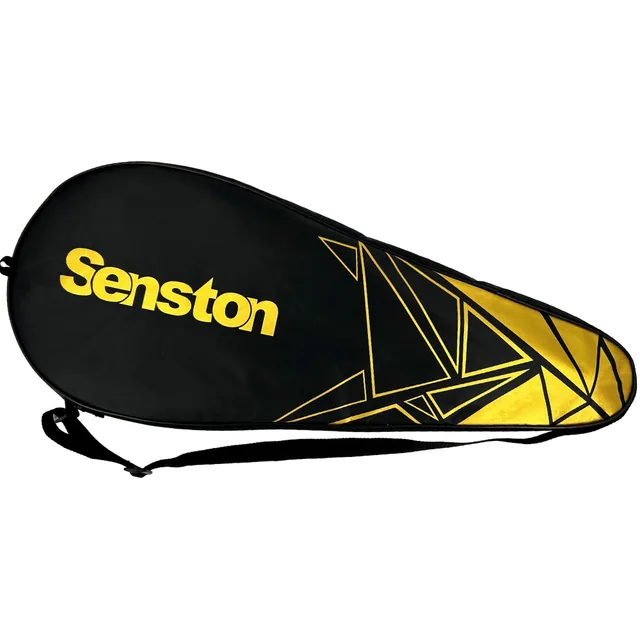
Senston Single Tennis Racket Cover
A zip cover with a shoulder strap, sized for one 27-inch racket, for keeping a single frame clean in the car.
| Feature | Single Tennis Racket Cover | Tennis and Badminton Racket Bag |
|---|---|---|
| Size | 28.34 × 11.41 in | 28.34 × 11.4 × 7.1 in |
| Holds | One 27-inch racket | 3 or 4 tennis rackets, or 5 or 6 badminton rackets |
| Pockets | Main zip only | 2 main compartments, 3 side pockets |
| Good for | One racket in the car | Rackets, balls and shoes in one bag |
The bag is for players who carry more. Families who play both sports often use one bag for both. If badminton is on your list too, read our badminton and ping pong at home piece for sets, shuttles and net height.
Kids rackets come with their own cover or carry bag, so a kid starting out does not need a separate bag. When your child starts carrying two rackets, a water bottle and a change of shoes to lessons, that is the time for the bigger bag.
Which tennis balls and practice gear go with a new racket?
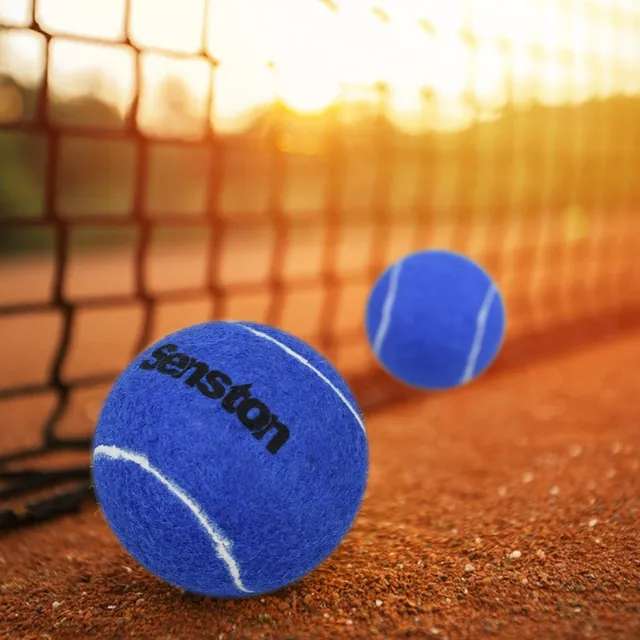
For hitting at the park, our Tennis Balls, 3 Pack are 2.4 inches across, with natural rubber and wool felt, and work on hard and soft courts. They are practice balls, not tournament balls.
If you play sanctioned matches, the event will tell you which ball to bring, and it will be an approved can. Our balls are not that. They are for practice, for the first summer of lessons and for the dog’s fetch box. The adult set for two already has three balls in the bag.
Solo practice is where our Tennis Trainer Ball with String comes in. You get two balls, each on a 3.8-meter elastic cord that stretches to 7.5 meters. You hit the ball, and the cord brings it back toward you.
- Tennis ball
- 2.4 in across
- Balls in the pack
- 3
- Trainer cord
- 3.8 m
- Stretched cord
- 7.5 m
Kids can swing over and over without walking after every ball. Be clear on what a trainer ball is, though. It is a swing tool, not a rally partner.

Senston Tennis Trainer Ball with String, 2 Pack
Two balls on 3.8-meter elastic cords that stretch to 7.5 meters, for swing practice in a yard without chasing every ball.
Buyers tell us that it takes coordination to keep the ball coming back to a spot where you can hit it. Some say the elastic gets in the way of a natural tennis swing. For a young beginner, it is a fun way to make contact many times in a row. For a player working on timing with a moving ball, a wall or a partner works better.
Tip: Start the trainer ball with slow, short swings. Buyers tell us that a hard hit sends it back fast and off to the side.
If your kids play more than tennis, read ball sizes by age next. Our size guide puts all our measurements in one place.
Are beach tennis paddles the same as tennis rackets?
No: our Beach Tennis Paddles have a solid graphite composite face over an EVA memory core and no strings. They come in packs of 2 or 4 and are made for beach tennis on the sand.
A tennis racket has a strung head, and the strings give the ball its bounce off the frame. A beach paddle has a solid face with holes in it, and you use it on sand, where a ball barely bounces. You cannot learn a tennis forehand with a paddle and then swap to a racket without a change. If you want your kid to learn tennis, buy a tennis racket.
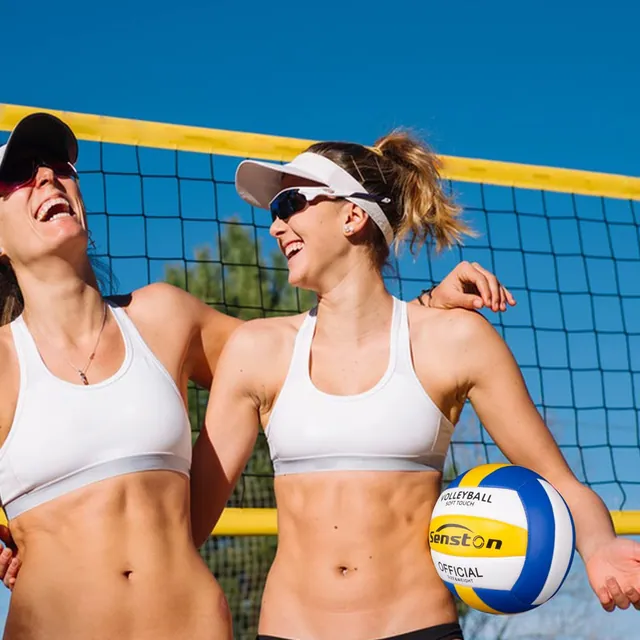
That said, a pair of paddles is a lot of fun at the beach. They come in a pack of two in blue and pink, or a pack of four with two pink and two blue. Four paddles let two pairs play at once.
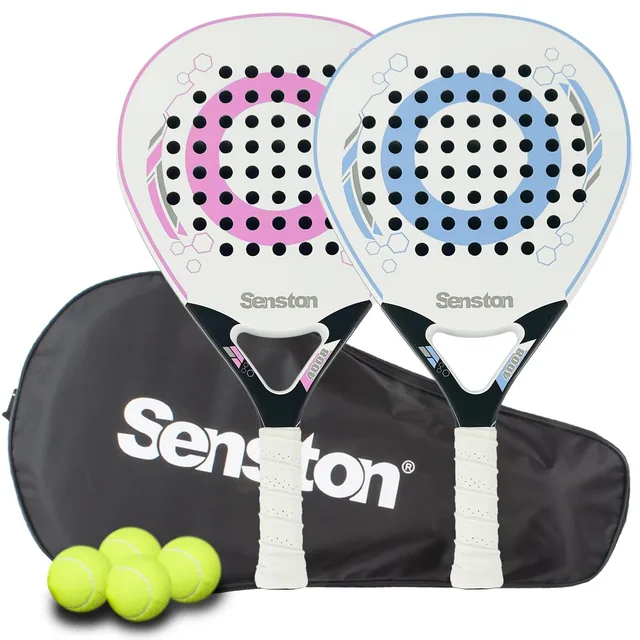
Senston Beach Tennis Paddles, Carbon Fiber with EVA Core
Graphite-face paddles with an EVA core in packs of two or four, for beach tennis on the sand, not court tennis.
Should you wear an elbow brace for tennis?
Wear one only for comfort. Our Elbow Brace with Springs is an open, adjustable strap with two stainless steel springs, one size up to 14.5 inches around the elbow, for the left or right arm.
Some players like the snug feel of a strap on the forearm while they play, and that is what it is for. If your elbow hurts, see a doctor before you play through it. A brace does not fix pain, and it should not keep you on court when your arm tells you to stop.
Tip: Elbow pain is a reason to see a doctor, not to buy a brace. The brace is comfort support during play and nothing more.
Buyers who like it talk about a snug fit. Buyers who do not like it talk about putting it on. Some say it is hard to put on by yourself, with one hand. Practice putting it on at home before your first match, not at the court with a partner waiting.
You will find it with our other odds and ends in Backyard & More.
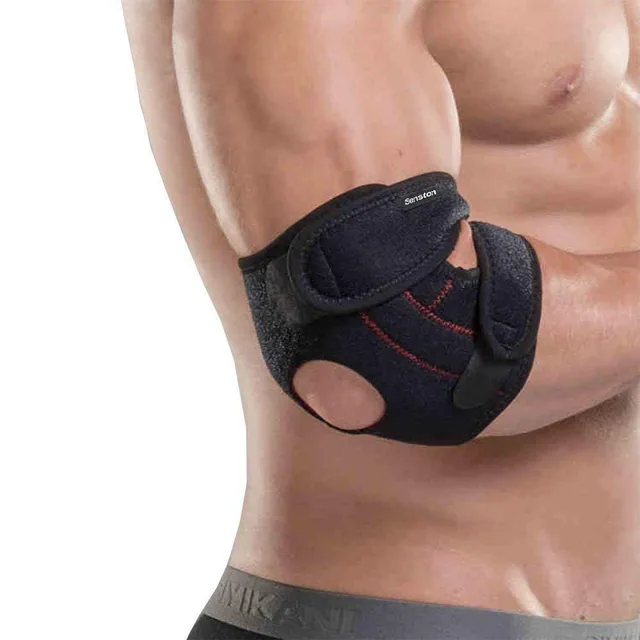
Senston Elbow Brace with Springs
One adjustable strap with two stainless steel springs, for either arm up to 14.5 inches around, worn for comfort during play.
When should you buy a different racket instead of ours?
Buy something else if you want a graphite performance frame, need a grip bigger than 4 1/4 inches or need balls for sanctioned matches. Our rackets are aluminum frames for kids and adults who are learning or play for fun.
- Our kids rackets
- 17 to 25 in
- Our adult rackets
- 27 in
- Adult racket grip
- 4 1/4 in
Here is the list, plainly:
- You hit hard, play in a league and want a graphite frame tuned for your swing. Our adult rackets are aluminum alloy, built for learning and casual play.
- You have a large hand and need a grip size above 4 1/4 inches. We do not make a bigger grip, and overgrips add only a thin layer.
- Your coach wants a 26-inch racket for your child. We go from 25 inches to 27 inches.
- You need balls for a tournament or a sanctioned match. Buy the approved can the event asks for.
- Your teenager trains with a coach several times a week. Ask the coach. They know the swing.
- You want to learn court tennis, and you are looking at paddles. Paddles are for the beach game.
Tip: Not sure about grip size? Try one overgrip first. If the handle still feels thin after that, a racket with a bigger base grip is the right call.
Everybody else, which is most families with a new player, will do fine with a Senston racket. You can read more about Senston and the sports Senston covers.
A simple plan for the first racket
Choosing a first racket comes down to three steps:
| Step | What to do |
|---|---|
| 1 | Find your child’s band in the USTA table, or go straight to 27 inches if you are an adult. |
| 2 | Do the arm-down test. The head should stop just above the floor. |
| 3 | Put a fresh overgrip on before the first lesson and keep the spare in the cover or bag. |
Our full range of rackets, balls, bags and dampeners is in the tennis collection, and every Senston overgrip and grip tape is in grips and tape.
Keep reading
If your family plays more than one sport, read ball sizes by age for basketball, soccer, volleyball and football. For the backyard and the basement, read badminton and ping pong at home, with sets for two and four players, shuttles, nets and paddles.
Sources
- USTA, Pick the Right Racquet, read October 28, 2026.
Keep reading

Ball Sizes by Age: Basketball, Soccer, Volleyball, Football
Ball sizes by age for basketball, soccer, volleyball and football, from the youth rule books, and which Senston ball fits a kid, a teen or an adult.
Read the article
Badminton and Ping Pong at Home: Sets, Paddles, Space
Backyard badminton and home ping pong: net height, racket grams, nylon or feather shuttles, table size, 5-ply or 7-ply paddles and the room you need.
Read the article