

Why does “size 5” mean three different things?
A size 5 basketball is the small 27.5-inch youth ball, while a #5 soccer ball is the full adult ball at 27 to 28 inches around. The number is a label inside each sport, not a shared scale.
- Size 5 basketball
- 27.5 in
- #5 soccer ball
- 27-28 in
- Volleyball game ball
- 65-67 cm
So the first thing to settle is the sport, and the second is the age group your kid plays in. USA Basketball and US Youth Soccer both print clear tables by age. Volleyball rules set one game ball by weight and circumference. For American football we lean on a ball maker’s guide from Wilson, and we say so each time.
The numbers in the charts come from those documents, read in October 2026. Where a league or a state association sets its own rule, theirs wins on game day. Our part is the ball your child kicks, dribbles or throws in the yard the other six days of the week. Our size guide puts the same charts side by side if you want them on one sheet.
Tip: Settle the sport first, then your kid’s age group. If a league or club sets its own rule, theirs wins, so ask the coach before you buy a game ball.
Racket sports size by length and grip instead of circumference. If tennis is next on your list, how to choose a tennis racket goes through racket lengths from 17 to 25 inches by age, and when to move up to 27.
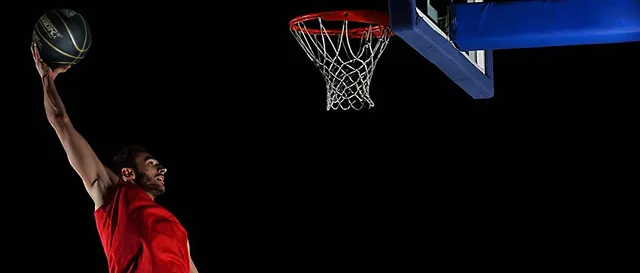
What size basketball does a child need?
A child aged 7 or 8 needs a size 5 basketball, 27.5 inches around, and a child aged 9 to 11 needs a size 6 at 28.5 inches. That is the USA Basketball and NBA guideline, and it is the same for boys and girls until age 12.
- Ages 7-8
- Size 5, 27.5 in
- Ages 9-11
- Size 6, 28.5 in
- Boys 12 and up
- Size 7, 29.5 in
- Girls 12 and up
- Size 6, 28.5 in
From 12 the table splits. Boys move to a size 7, 29.5 inches around, and they keep it through high school. Girls stay on the size 6 from age 12 right through grades 9 to 12.
If you have a daughter in middle school, the 28.5-inch ball is not a step down. It is the ball her age group plays with, and it will still be her ball as a senior.
| Playing segment | Girls | Boys | Height of basket |
|---|---|---|---|
| Ages 7-8 | Size 5 (27.5 in) | Size 5 (27.5 in) | 8 ft |
| Ages 9-11 | Size 6 (28.5 in) | Size 6 (28.5 in) | 9 ft |
| Ages 12-14 | Size 6 (28.5 in) | Size 7 (29.5 in) | 10 ft |
| Grades 9-12 | Size 6 (28.5 in) | Size 7 (29.5 in) | 10 ft |
The basket drops too. Kids aged 7 and 8 shoot at an 8-foot rim, kids 9 to 11 at a 9-foot rim, and everyone from 12 at the regular 10 feet. If your driveway hoop adjusts, you can match it to the table the same way you match the ball.
“A smaller basketball for the younger age segments is advised due to the size of a child’s hand as well as their developing skill level. A smaller ball allows for better control and success.”
USA Basketball, Youth Basketball Guidelines
That line is the whole case for buying the small ball. A hand that cannot spread over the ball has to push it with both palms. When the ball fits the fingers, a young player can dribble with one hand and shoot with a wrist that bends. That is the success the guideline talks about, and at 8 it matters more than any name on the cover.
What about kids younger than 7?
The guidelines start at ages 7 and 8, so for a preschooler you go by the hand and by the height of the hoop. Our smallest ball is the 25.5-inch size 3 in the Colorful Outdoor Basketball family, which also runs up through sizes 5, 6 and 7.
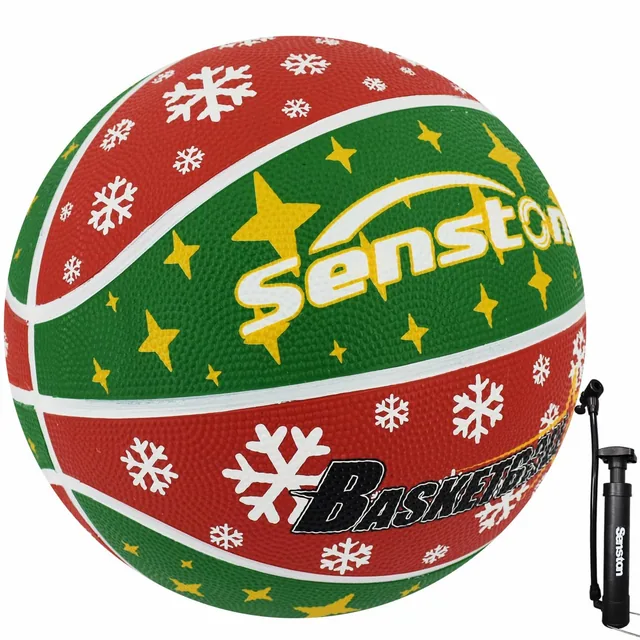
Senston Colorful Outdoor Basketball, Sizes 3 to 7
It starts at a 25.5-inch size 3 for preschoolers and goes up to a full size 7, all with nylon windings and a butyl bladder.
If your child is 3 or older and already plays with a bigger kid, the Kids Basketball, 27.5 in is a pink and black size 5. It is the same size the table gives a 7-year-old, so it can follow them into their first team season. A 4-year-old will find it big at first, and that is fine for rolling, passing and two-handed shots at a low rim.
Rubber or composite cover?
Pick rubber for concrete driveways and park courts, and a PU leather cover for gym floors and smooth courts. Our most-rated ball, the Outdoor Basketball with Pump, is rubber in sizes 5, 6 and 7, with 80% nylon windings to keep its shape and a butyl bladder to hold air.
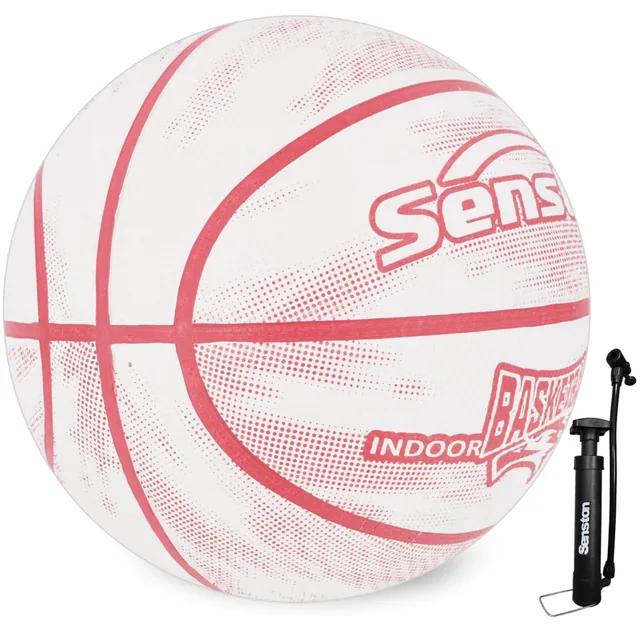
Senston Outdoor Basketball with Pump
A rubber ball in size 5, 6 or 7 that can live on a concrete driveway, with a pump in the box.
A PU leather cover feels softer in the hands. Our PU Leather Basketball is a size 7 in black with gold or red, for gym nights and smooth outdoor courts. On rough asphalt every day it will wear faster than rubber does. If the ball is going to spend its life on the street, pick rubber and keep the PU ball for the gym.
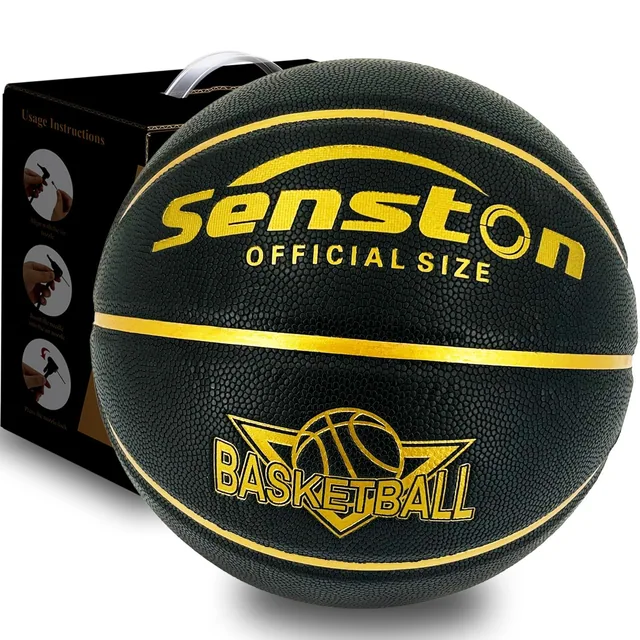
Senston PU Leather Basketball, Size 7
A size 7 with a PU leather cover for players who want a softer touch on smooth courts and gym floors.
Neither of these is a league game ball. Players in an indoor league on hardwood expect a composite leather ball. Our rubber balls are made for the driveway, the park and practice, and that is where they make sense.
One ball for the parent, one for the kid
A family hoop has a problem a single ball cannot solve: an adult needs a 7 and a 7-year-old needs a 5. Our Two-Basketball Set puts a 27.5-inch size 5 in the box next to a size 7 or a size 6. The size 6 version suits a mother and daughter, since the girls’ table stays on the size 6 through high school.

Senston Two-Basketball Set for Parent and Child
Two rubber balls in one box, a size 7 or 6 for the grown-up and a 27.5-inch size 5 for the child.
Teenagers who outgrow the size 5 often want their own ball for the car or the gym bag. The Durable Rubber Basketball comes in size 6 for girls and for players 9 to 11, and in size 7 for boys from 12. It is not the right buy for a kid under 9, who will handle a size 5 far better.
Dribbling indoors without the thump
If you live in an apartment, a real basketball on a hard floor is the fastest way to meet your downstairs neighbor. The Silent Foam Basketball is a size 5 with a dense foam core and a nylon cover, about 450 grams. It is not compressed for the trip, so your kid can start dribbling as soon as the box is open.
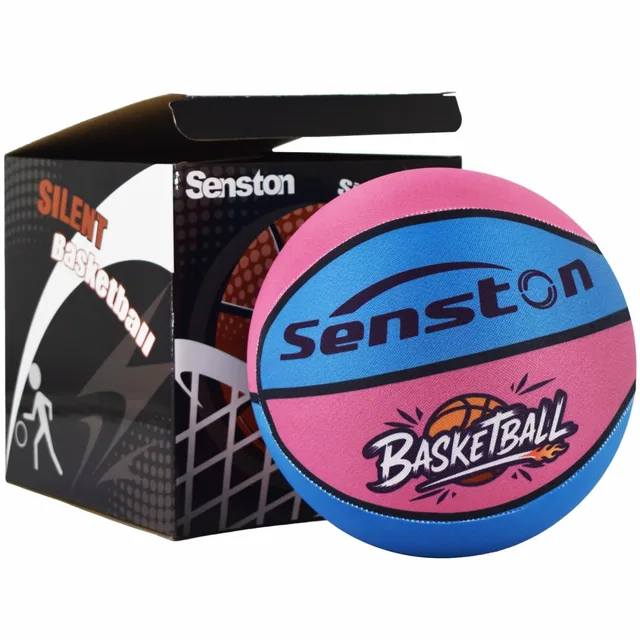
Senston Silent Foam Basketball, Size 5
A size 5 foam ball of about 450 grams for dribbling drills in a living room without the bang on the floor.
Be clear about what it is. It is a practice ball for handling and dribbling, not a game ball, and it will not behave like rubber on an outdoor hoop. For other games that fit inside a house, badminton and ping pong at home covers sets for two and four players. You can browse every size and cover in our basketballs.
What size soccer ball does my child need?
US Youth Soccer gives a #3 ball to the 6 and under and 8 and under groups, and a #4 to the 10, 11 and 12 and under groups. Every group from 13 and under plays a #5, which is 27 to 28 inches around and weighs 14 to 16 ounces.
| Age group | Ball | Circumference | Weight |
|---|---|---|---|
| 6 and under | #3 | 23-24 in | 11-12 oz |
| 8 and under | #3 | 23-24 in | 11-12 oz |
| 10 and under | #4 | 25-26 in | 11-13 oz |
| 11 and under, 12 and under | #4 | 25-26 in | 11-13 oz |
| 13 and under to 19 and under | #5 | 27-28 in | 14-16 oz |
The table has no row for 9. A 9-year-old falls inside “10 years of age and under”, so the #4 line is the one that covers them. Rule 303 also opens with “Except as provided by USYSA and its State Associations”, which means your state or club can set its own groups. If you are buying for game day, ask the coach which ball the team uses.
Tip: For a 9-year-old, start with a #4 ball. It is the size the 10 and under line gives, and it weighs about the same as a #3.
Look at the weight column, not only the size. A #3 and a #4 weigh almost the same, 11 to 12 ounces against 11 to 13. The step a young player feels is from the #4 to the #5, which is bigger by two inches around and heavier by about three ounces. A kid moving up to the 13 and under group will kick a ball that is both, so it helps to get the #5 into the yard a few weeks before the season.
Heading: a side note for parents of younger players
Size is not the only thing that changes with age. The same rule book has a section on heading, and it is short and firm.
“All Players age 10 years of age and under shall not head the ball directly from the air in any match or competition, nor shall these players practice heading the ball in any organized team setting.”
US Youth Soccer, Policy on Players and Playing Rules, Rule 305
Players aged 11 and 12 may head the ball in games, and coaches have to make sure no player heads it more than 25 times a week in practice. From 13, players can head the ball in games and in practice. The rule is mandatory at US Youth Soccer events, and state associations are strongly encouraged to adopt it.
For a backyard ball this changes nothing about size, but it does change the drills you run with a 9-year-old. Keep the ball on the ground and at their feet.
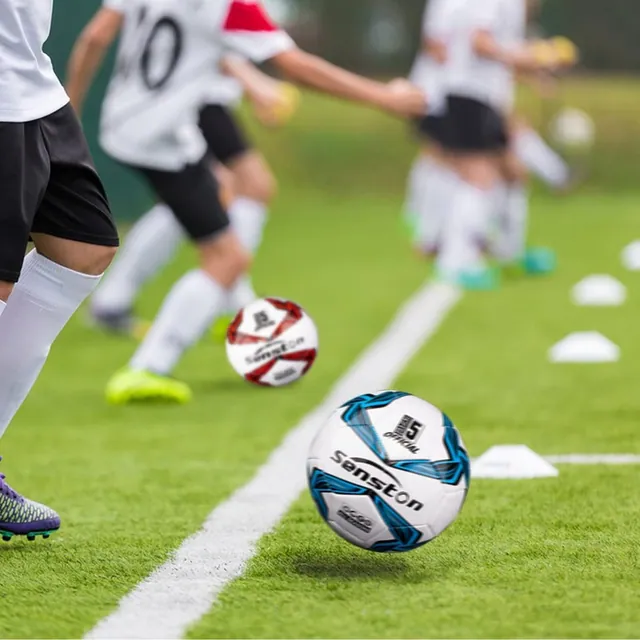
Our soccer balls by size
The Soccer Ball with Pump is the classic 32-panel ball, with 12 pentagons and 20 hexagons. Under the waterproof PVC shell sits a soft layer of foamed EVA, then nylon winding and a butyl bladder. You can pick it in size 3, 4 or 5, so the same ball can follow a child from 6 and under to the adult game.
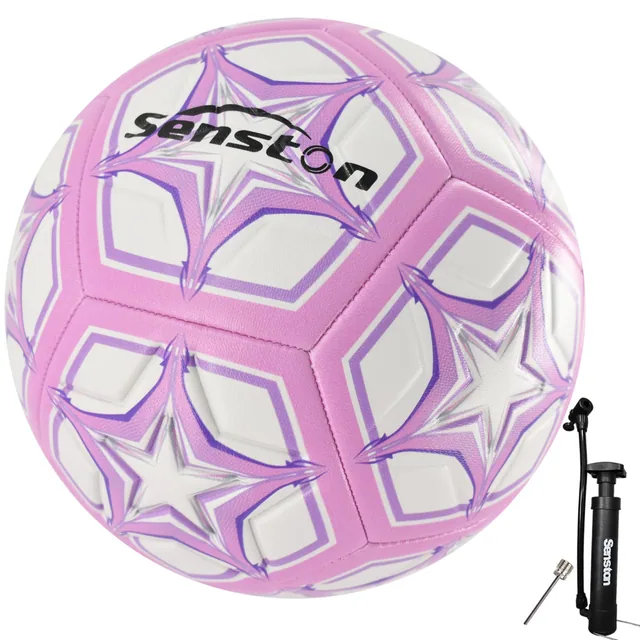
Senston Soccer Ball with Pump, Sizes 3, 4 and 5
The classic 32-panel ball in size 3, 4 or 5, with a pump, for backyard games and team practice.
The Stable-Flight Soccer Ball is a three-layer ball in yellow, white or black, also in sizes 3, 4 and 5. Its smooth PVC wipes clean with a damp cloth after a muddy session, which parents tend to like more than kids do. It has no padded foam layer like the classic ball, so a player who wants a soft touch will prefer the first one.

Senston Stable-Flight Soccer Ball, Sizes 3, 4 and 5
A three-layer ball in sizes 3, 4 and 5 whose smooth PVC wipes clean with a damp cloth.
For older kids who train a lot, the PVC Training Soccer Ball comes in size 4 and 5, with thickened nylon winding to hold its shape and a pump with needles in the box. For summer evenings, the Glow-in-the-Dark Soccer Ball is a size 5 PU ball that charges in sunlight and glows for about an hour after dark. That makes it a ball for the last game before bed, not for a full night match.
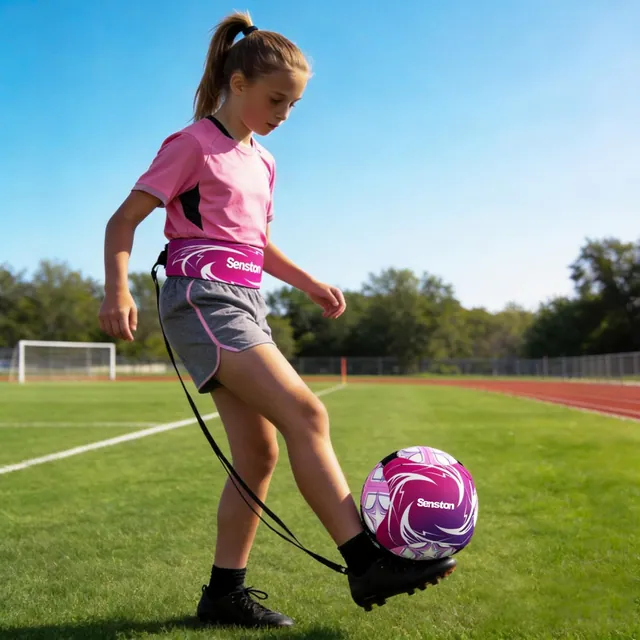
A kid who wants to practice alone runs into one problem fast: chasing the ball. The Soccer and Volleyball Training Belt holds a ball in a harness on a 6.5-foot elastic cord that stretches to 18 feet. It fits ball sizes 3, 4 and 5, so it works with whatever ball the age table gives your child. One belt serves one player, so it is a tool for solo practice, not for team drills.

Senston Soccer and Volleyball Training Belt
A waist belt and elastic cord that fits ball sizes 3, 4 and 5, so one player can kick and receive without chasing the ball.
A soft ball for the hallway
Indoor soccer in a home is a different game. The Silent Indoor Soccer Ball is a size 4 in neoprene and weighs 160 grams, or 5.64 ounces. A #4 game ball under Rule 303 weighs 11 to 13 ounces, so this one is less than half of that. It will not mark walls or knock a lamp over with a thud, and it is useless for outdoor games for the same reason.

Senston Silent Indoor Soccer Ball, Size 4
A 160-gram neoprene size 4 for touches in the hallway on rainy days, far lighter than a game ball.
All of our soccer balls, from the #3 to the #5, sit together in soccer balls.
What size volleyball do kids and adults use?
Volleyball has one game ball for everyone under the FIVB rules: 65 to 67 centimeters around and 260 to 280 grams. Our Soft Volleyball, Official Size 5, weighs 8 ounces, about 227 grams, so it is lighter than that range, and our pool balls weigh 190 grams.
“Its circumference is 65-67 cm and its weight is 260-280 g.”
FIVB, Official Volleyball Rules 2025-2028, Rule 3.1
The same rule asks for a case of leather or synthetic leather with a bladder of rubber or a similar material inside. It also sets the inside pressure at 4.26 to 4.61 psi. Every ball in one match has to match the others on circumference, weight, pressure and type.
The FIVB rule book is about the official game, and it does not give a lighter ball for kids. So for a young player, think about weight and feel, not about a size number. A soft cover that does not sting the forearms does more for a 10-year-old learning to pass than a match skin will. Once a teenager joins a school or club team, the team ball takes over and the home ball becomes a practice ball.
| Ball | Weight | Build | Where it fits |
|---|---|---|---|
| FIVB game ball (Rule 3.1) | 260-280 g | Leather or synthetic leather case, 65-67 cm around | Matches under FIVB rules |
| Soft Volleyball, Official Size 5 | 8 oz (about 227 g) | Synthetic leather, butyl bladder | Beach, park and school gym |
| Soft Silent Indoor Volleyball | 190 g | Soft cushioned cover, 63-68 cm around | Rec rooms, dorms and pools |
| Pool Volleyball Two-Pack, pool ball | 190 g | Light elastic shell, 63-68 cm around | Pool play |
| Pool Volleyball Two-Pack, second ball | 280 g | Synthetic leather | Beach court |
Soft, light and pool balls
The Soft Volleyball, Official Size 5 has 18 machine-stitched panels and a soft synthetic leather skin over a butyl bladder. It is made for the beach, the park and the school gym, not for sanctioned indoor matches that call for an approved game ball.
Not every buyer got a good one, and one wrote, “Ordered 2 neither hold air longer than a day.” Check yours the day after you pump it.
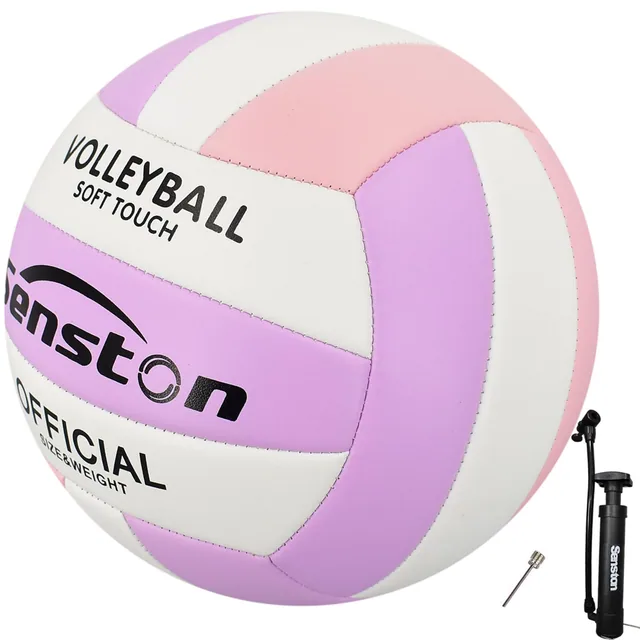
Senston Soft Volleyball, Official Size 5
An 18-panel size 5 with a soft synthetic leather skin for casual beach and backyard games.
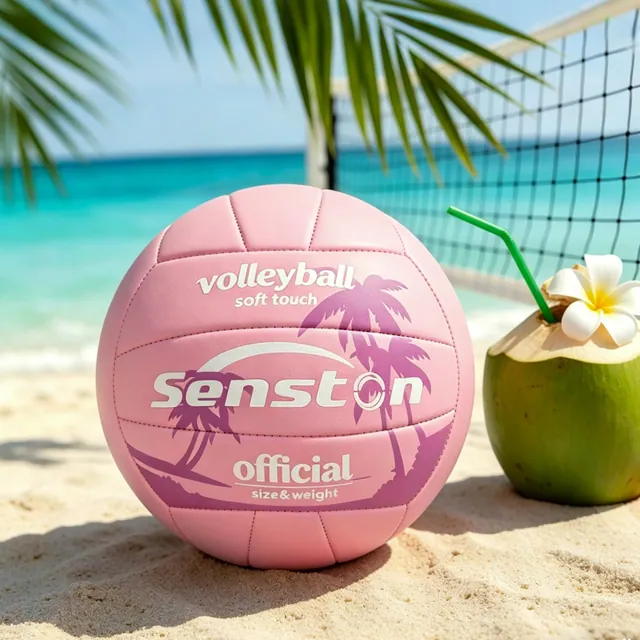
The Printed Volleyball, Size 5 is the same soft size 5 build with printed covers in pink mint, pink palm or blue. A printed ball is easy to spot in the sand, which counts for more on a crowded beach than you would think.
The Soft Silent Indoor Volleyball weighs 190 grams and measures 63 to 68 centimeters around, so it is close to the size of a game ball at about two thirds of the weight. Its cushioned cover lets a kid set and bump in a rec room without loud smacks, and it is light enough to float in the pool. It is the wrong ball for spiking practice, because it is much lighter than a 260 to 280 gram game ball.
Senston Soft Silent Indoor Volleyball
A 190-gram ball with a cushioned cover for setting and bumping indoors without loud smacks.
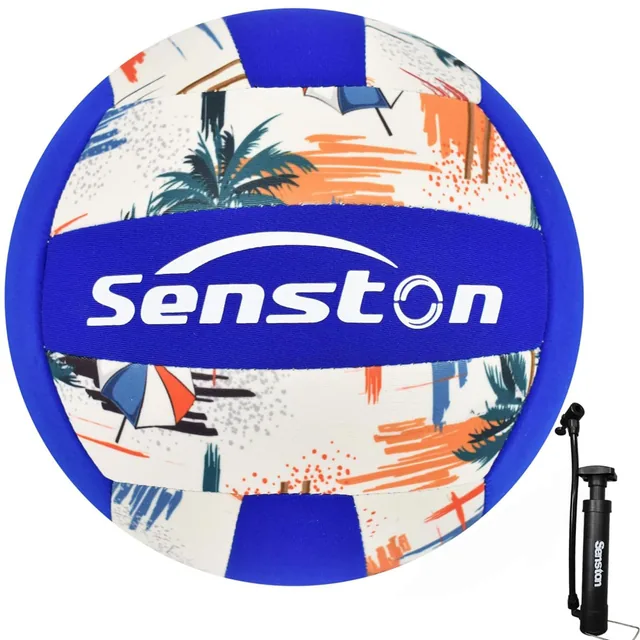
If your summer moves between the pool and the sand, the Pool Volleyball Two-Pack has one ball for each. You get a 190-gram pool ball that floats and stays soft on the hands, and a 280-gram synthetic leather ball for the beach court. That second ball sits at the top of the FIVB weight range, so its weight is close to a game ball’s.
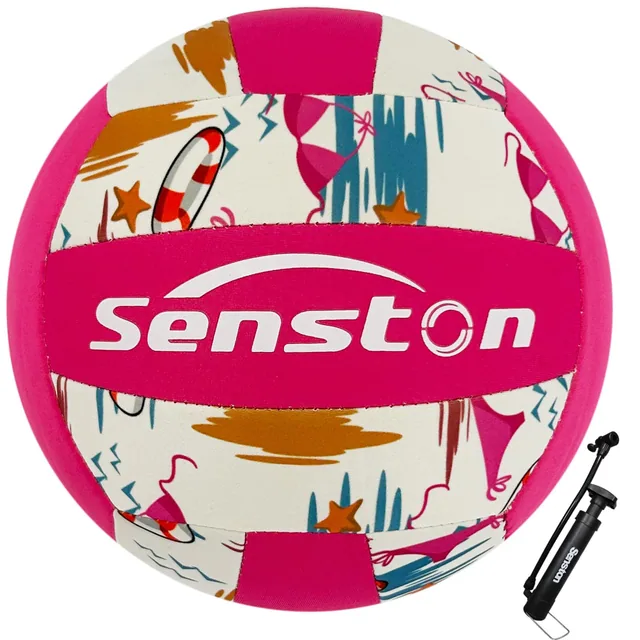
Senston Pool Volleyball Two-Pack
A 190-gram pool ball and a 280-gram beach ball in one box, with two pumps.

How much air should a volleyball have?
A game ball under FIVB rules runs at 4.26 to 4.61 psi, and you need a gauge to hit that range. Our Soft Volleyball, Official Size 5, is a casual ball, and it does not need to be pumped that full.
Tip: Push the needle in straight and slowly so it does not puncture the bladder, and stop pumping before the ball feels hard.
A slightly softer ball is kinder to young arms on the beach. The silent ball has its own warning: do not over-inflate it, or it can lose its shape. Every one of our volleyballs is in volleyballs, from the 190-gram pool ball to the size 5 beach ball.
What size football does my child need?
Wilson’s buying guide puts kids 6 to 9 on a pee wee football, kids 9 to 12 on a junior ball and kids 12 to 14 on a youth ball, with high school and college balls from 14. Our footballs come in junior size 6 and official size 9.
- Pee wee
- Ages 6 to 9
- Junior
- Ages 9 to 12
- Youth
- Ages 12 to 14
- High school and college
- 14 and up
This is a manufacturer’s guide, not a league rule. Soccer and basketball have tables from national bodies, but the football chart comes from a company that makes balls. It is still useful, because it sorts balls by age and hand size in plain words.
“Pee wee footballs fit the hands of children ages 6 to 9. These small footballs allow children to grip the ball correctly and enjoy the success of learning to throw it accurately.”
Wilson, How to Choose a Football (manufacturer guide)
| Class | Ages | What the guide says |
|---|---|---|
| Pee wee | 6 to 9 | Fits small hands and keeps extra weight off the arm |
| Junior | 9 to 12 | Hands still smaller than an adult’s, with more skill and strength |
| Youth | 12 to 14 | Close in size to official college balls |
| High school and college | 14 and up | Slightly smaller than an official NFL-sized ball |
The ages overlap on purpose. A big 9-year-old can move up to a junior ball while a small one stays on a pee wee. The guide leans on the hand, so let your child hold both and watch whether their fingers reach the laces.
What do “size 6” and “size 9” mean on our footballs?
Our Composite Leather Football comes as Junior Size 6 and Official Size 9, and the size 9 box line reads “High School Football Official Size 9” with a mark for age 14 and up. That matches the Wilson class for high school balls, which the guide gives to players 14 and up.

Senston Composite Leather Football, Size 6 and 9
A textured composite leather football in junior size 6 or official size 9, with a pump and needle in the box.
The size 6 carries the junior name, so it belongs with the junior years in the table. Wilson’s guide sorts balls by class and age, not by a number, so the class name tells you more than the digit does. If your child sits on the line between two classes, check the ball against their hand before a season, not after.
Composite or leather?
For a kid’s first real football, composite is the usual choice, and our Composite Leather Football in size 6 or size 9 is built that way. The Wilson guide explains why parents and coaches tend to pick it.
“The texture of composite footballs makes them easy to grip, and the material resists moisture better than natural leather.”
Wilson, How to Choose a Football (manufacturer guide)
Our composite leather football has a textured surface for grip and a butyl bladder that holds air and shape. It is made for backyard catch and beginner practice. It is not the ball for league games that name a specific game ball, so if your kid’s team has an official ball, buy that one for games and use ours for the yard.
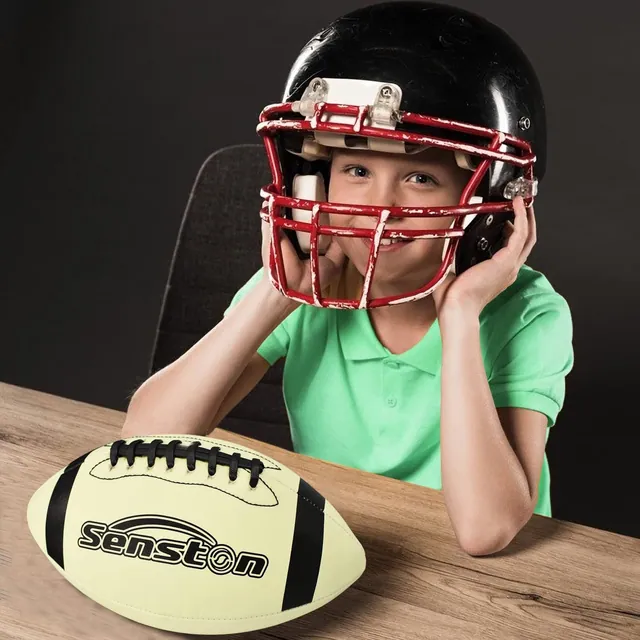
For pool and lake days there is the Waterproof Pool Football, a 9.25-inch neoprene ball with double laces that stays grippy when wet. It is a ball for water and sand. On a field, players expect composite leather, and this one will feel too soft.
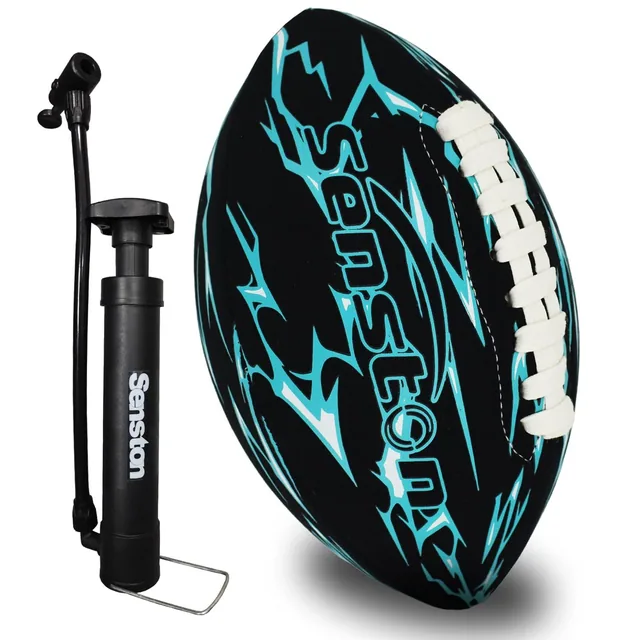
Senston Waterproof Pool Football, 9.25 in
A 9.25-inch neoprene football with double laces that stays grippy in the pool.
Kids who play every season often get two balls at once. Our Football Two-Ball Sets pair a size 9 with the pool football, a size 9 with a size 7 basketball, or a glow-in-the-dark size 6 football with a 29.5-inch basketball. Every football in our range, for kids and adults, is in footballs.
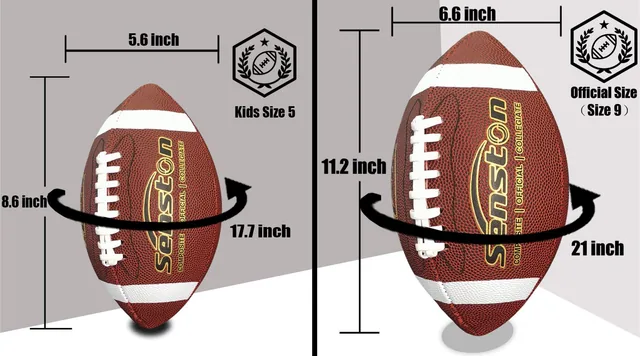
Senston Football Two-Ball Sets
A football boxed with a second ball, from the pool football to a glow-in-the-dark size 6 with a basketball.
How hard should you pump each ball?
Use the pressure printed on the ball if there is one, and go by that number over anything else. For a volleyball, the FIVB game ball range of 4.26 to 4.61 psi is a sound reference.
- Volleyball game ball
- 4.26-4.61 psi
- Silent soccer ball back to round
- 3 to 4 hours
- Glow after dark
- About 1 hour
For the other balls, the figure on the ball itself is the one to trust. Many of our balls arrive flat, with a pump in the box. The PU leather basketball, the kids basketball, the glow balls, the football and the soft volleyball all travel deflated and need air before the first game.
Tip: Several boxes hold a needle that is small enough to vanish in the packaging. Find it before you throw the box away.
Pump in short strokes and stop to squeeze the ball as you go. A ball that is too hard stings hands and bounces wild, and a ball that is too soft dies on the floor. For the silent soccer ball and the silent volleyball, over-inflating is the real risk. The silent soccer ball may not look round right after you pump it, and it comes back to shape in 3 to 4 hours.
The silent basketball is the odd one out. It is not compressed for the trip, so your kid can start dribbling it the day it arrives.
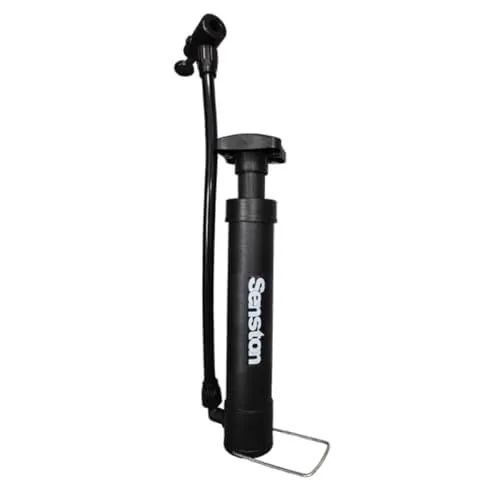
Senston Ball Pump
A spare hand pump for the ball bin that fits basketballs, soccer balls, volleyballs and footballs.
Pump a new ball on the day it comes, then check it the next morning. One buyer of our colorful basketball wrote that it “Came in discolored and doesn’t hold air”. A slow leak shows in the first few days, while the box is still on the porch, and that is the time to find it.
How do you keep a ball in good shape?
Match the cover to the ground: a rubber basketball takes concrete every day, and the PU Leather Basketball, Size 7 suits gym floors and smooth courts. Our Stable-Flight Soccer Ball wipes clean with a damp cloth, and the neoprene pool balls are made for water and sand.

Glow balls need sunlight to work. Leave the glow soccer ball or glow volleyball in the sun during the day, and expect about an hour of glow after dark. Some buyers wanted more, and one said, “Glow doesn’t last very long and takes a long time to absorb light.”
Tip: Planning a late beach game? Charge the glow ball in full sun first, and expect about an hour of glow once it gets dark.
Bring balls inside at night when you can, and keep them away from the dog. A puppy can ruin a rubber ball in an afternoon, and no cover is built for teeth. If several kids share a bin, our personalized basketball arrives with a name on the cover, which ends the argument about whose ball it is.

Senston Personalized Basketball with Your Name
A basketball that arrives with the name you type in printed on the cover, so nobody mixes up balls at practice.
When should you buy a different ball?
If your child’s league names a game ball, buy that one for games and keep ours for the yard and practice. The same goes for spiking practice, where our 190-gram pool ball is far lighter than a 260 to 280 gram game ball.
Our balls are for backyards, driveways, beaches and practice. Here are the other cases where you should look elsewhere:
- Your child’s league names an official game ball, in basketball, soccer, volleyball or football. Buy that one for games.
- A turf soccer match that calls for the match ball your league names. Our soccer balls are for practice and backyard games.
- Sanctioned indoor volleyball matches that require an approved game ball.
- An indoor basketball league on hardwood, where players expect a composite leather feel and our rubber ball will feel wrong.
- Full night games. The glow balls fade after about an hour.

For everything else, the age tables do most of the work. Pick the sport, find your kid’s age group, and buy that size. If you want to know more about who we are and what our range covers, read about Senston.
Keep reading
Keep reading: if racket sports come next, how to choose a tennis racket covers lengths by age, grip size and overgrips. For indoor and yard games, badminton and ping pong at home helps you set up a backyard court or a basement table for two or four players.
Sources
- USA Basketball, Youth Basketball Guidelines, read October 28, 2026.
- US Youth Soccer, Policy on Players and Playing Rules, June 23, 2026, read October 28, 2026.
- FIVB Official Volleyball Rules 2025–2028, read October 28, 2026.
- Wilson, How to Choose a Football (manufacturer guide), read October 28, 2026.
Keep reading
How to Choose a Tennis Racket for a Kid or an Adult
Racket length by age from 17 to 27 inches, the 4 1/4 inch grip, overgrips and how to wrap one, dampeners, covers, bags and beach tennis paddles.
Read the article
Badminton and Ping Pong at Home: Sets, Paddles, Space
Backyard badminton and home ping pong: net height, racket grams, nylon or feather shuttles, table size, 5-ply or 7-ply paddles and the room you need.
Read the article