
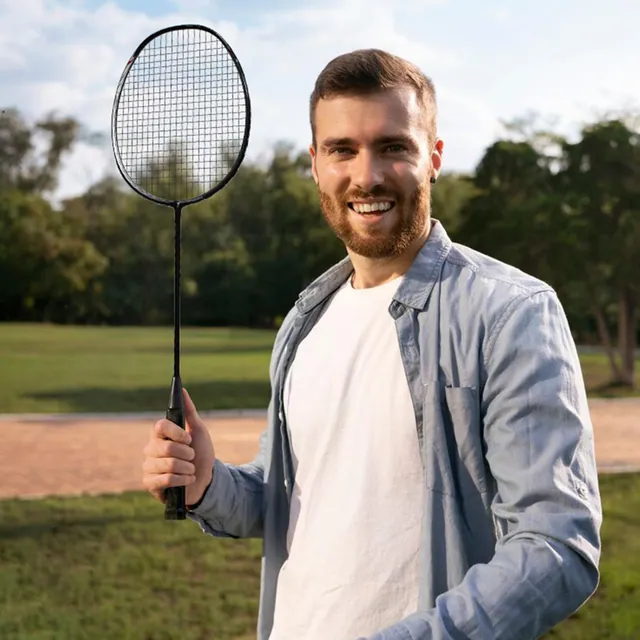
What do you need to play badminton in the backyard?
You need one racket per player, a handful of nylon shuttlecocks and something to hit over. Our Carbon Fiber Badminton Set for 4 Players puts four rackets, six nylon shuttles, four grips and a bag in one box, so all you add is a net or a rope.
- Rackets in the set for 4
- 4
- Nylon shuttles
- 6
- Spare grips
- 4
- Racket weight
- about 90 g
That is the whole kit for a summer evening. The Laws of Badminton describe a lot more: a marked court, posts, a net of a set depth and a shuttle that flies at a tested speed. Your yard does not need all of it. It needs a fair height to hit over, a flat patch of grass and enough shuttles that one lost in the hedge does not end the game.
We built our badminton range around that kind of play. The rackets are light, they come strung, and the sets carry their own grips and bags. They are for families, friends and people who are still learning. If you play in a club and string your own rackets tight, our sets are probably not for you.
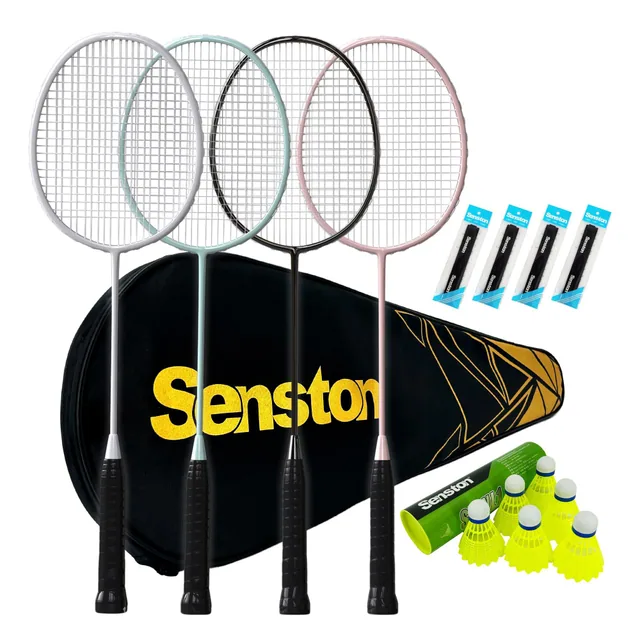
Senston Carbon Fiber Badminton Set for 4 Players
Four carbon rackets at about 90 g, six nylon shuttles, four grips and a bag cover a doubles game in the yard from one box.
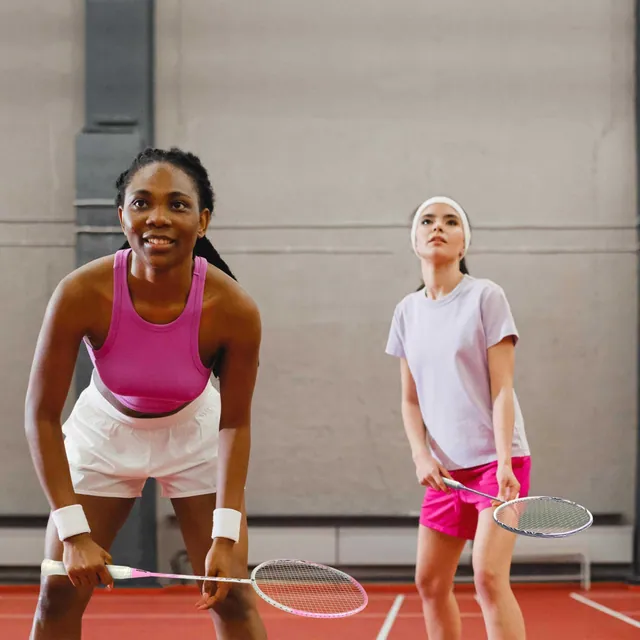
How high should a badminton net be at home?
Set the top of the net at 1.55 m at the posts and let it dip to 1.524 m in the middle. Those two numbers come straight from the rule book, and they work as well over a lawn as over a gym floor.
“The top of the net from the surface of the court shall be 1.524 metres at the centre of the court and 1.55 metres over the side lines for doubles.”
BWF, Laws of Badminton, Law 1
The posts themselves stand 1.55 metres tall, and the laws put them on the doubles side lines whether you play singles or doubles. The net is 760 mm deep and at least 6.1 metres wide. On a real court the cord runs flush with the top of the posts, and there are no gaps between the net and the posts.
At home you can copy the height and relax about the rest. A garden net on poles, a rope tied between two trees or a strip of tape across a garage door will all do. What matters is that both sides hit over the same height. The laws allow the net to sag only 2.6 cm from post to middle, so pull yours tight before you start.
- Net top at the centre
- 1.524 m
- Net top at the posts
- 1.55 m
- Sag from post to middle
- 2.6 cm
If your net hangs much lower than 1.5 m, smashes get easy and rallies get short. If it sits much higher, kids will struggle to clear it at all. For a family with small children, you can drop it for a while and raise it as they grow.
Tip: Agree on the net height and the court lines before the first serve, so nobody argues about them at 19 to 18.
How big is the court? The laws draw it in a diagram, but a note under that diagram gives the corner to corner length of a full court as 14.723 m. Most backyards are smaller, and that is fine. Mark a shorter court with cones or a pair of shoes on each corner and keep the net height true. A short court with a fair net plays better than a full one with a slack rope.
| Item | Laws of Badminton |
|---|---|
| Net top at the centre | 1.524 m |
| Net top over the doubles side lines | 1.55 m |
| Post height | 1.55 m |
| Net depth | 760 mm |
| Net width | at least 6.1 m |
| Full court, corner to corner | 14.723 m |
| Shuttle weight | 4.74 to 5.50 g |
| Feathers on a feathered shuttle | 16 |
| Racket length | not more than 680 mm |
| Racket width | not more than 230 mm |
| Stringed area | not more than 280 mm long and 220 mm wide |
Should you buy a badminton set for 4 or a set for 2?
Buy the set for 4 if two pairs will ever play doubles: our 4-player carbon set has four rackets at about 90 g, six nylon shuttlecocks, four grips and one bag. Buy a set of 2 if it is mostly you and one partner.
Our Carbon Composite Badminton Set of 2 holds two rackets at about 90 g each, two nylon shuttlecocks, two spare grip tapes and a bag. The rackets come strung and ready. The set is honest about its job: casual rallies, family games and beginner practice, not tournament play. Couples and friends who rally in the park are who it suits.
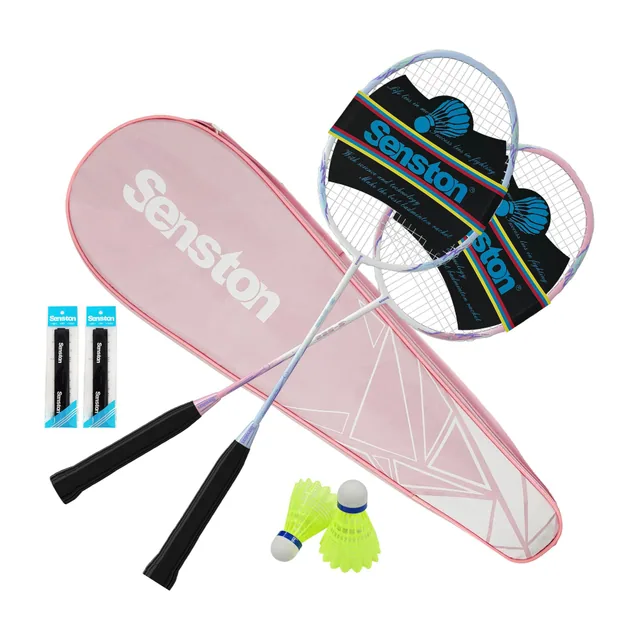
Senston Carbon Composite Badminton Set of 2
Two light carbon composite rackets with two spare grips and a bag are all a pair of park players need.
- Set for 4
- 4 rackets, 6 shuttles
- Set of 2
- 2 rackets, 2 shuttles
- Junior racket
- 58 cm, 95 g
There is also a metal frame option. Our Family Badminton Set with Bag comes with four rackets or two, soft foam handles, nylon shuttles, spare grips and a zip bag that holds it all after the game. It is the set we would hand to a group of kids at a picnic, where rackets get dropped on the patio. If you want a light carbon racket, it is the wrong pick.
For small players, the Junior Badminton Racket Set has two rackets at 58 cm (22.8 in) and 95 g, two nylon birds and a bag. It is made for kids who find a full 66 cm racket too long. It is not a racket for adults, and a grown-up will notice the short reach on the first swing. Our size guide keeps racket lengths and ball sizes for every sport on one page.
| Product | Players | Racket weight | Frame | In the box |
|---|---|---|---|---|
| Carbon Fiber Badminton Set for 4 Players | 4 | about 90 g | Full carbon fiber | 4 rackets, 6 nylon shuttlecocks, 4 grips, 1 bag |
| Carbon Composite Badminton Set of 2 | 2 | about 90 g | Carbon fiber composite | 2 rackets, 2 nylon shuttlecocks, 2 spare grips, 1 bag |
| N80 Carbon Fiber Badminton Rackets | 2 | 75 to 79 g, 5U | Full carbon fiber | 2 rackets with carry covers |
| Carbon Fiber Badminton Racket, 76 g | 1 | 76 g unstrung, 5U | Carbon fiber frame and shaft | 1 racket, 1 spare grip, 1 cover |
| Junior Badminton Racket Set | 2 | 95 g at 58 cm | Carbon and aluminum composite | 2 rackets, 2 nylon shuttlecocks, 1 bag |
Tip: Four players share six birds in the set for 4. Plan on a spare pack of shuttles in the first month, before one lands on the roof and another goes under the car.
How heavy should a badminton racket be?
For backyard play, a racket of about 90 g, like the ones in our two carbon sets, is light enough for most adults and teens. The 75 to 79 g N80 suits players who play every week and want a lighter frame that is easier on the arm over a long session.
Here is how our rackets line up in grams. The rackets in both carbon sets weigh about 90 g. The N80 Carbon Fiber Badminton Rackets come in at roughly 75 to 79 g each and sit in the 5U weight class. Our single 76 g carbon racket is also 5U, and its 76 g is measured unstrung. The junior racket weighs 95 g, slightly heavier than the adult carbon ones, with a carbon and aluminum frame and a length of 58 cm.
- N80 rackets
- 75 to 79 g
- Single carbon racket
- 76 g
- Set rackets
- about 90 g
- Junior racket
- 95 g
The U label is a weight class, and the gram figure tells you more than the letter does. When you set two rackets side by side, read the grams first. A lighter racket can help with arm and shoulder fatigue over a session of 90 minutes or more, so weekly players do well with the N80. For a few games after dinner, a 90 g racket is all you need.

Senston N80 Carbon Fiber Badminton Rackets, 2-Player Set
At 75 to 79 g in the 5U class, the N80 pair is the step up for players who have outgrown a backyard set.
The laws set an outer limit on size, not a target.
“The racket shall be a frame not exceeding 680 mm in overall length and 230 mm in overall width”
BWF, Laws of Badminton, Law 4
The strung area may be no more than 280 mm long and 220 mm wide. Our junior racket at 58 cm is 100 mm shorter than the 680 mm limit, and that is the point of it: a child gets a racket that fits their reach. Adults in the backyard can use any of the full length rackets in our range.
- Racket length limit
- 680 mm
- Our junior racket
- 580 mm
- Strung area limit
- 280 by 220 mm
Carbon or metal frame?
Carbon is the lighter choice: the rackets in our Carbon Composite Badminton Set of 2 weigh about 90 g each, lighter than many steel or aluminum rackets. Our Family Badminton Set uses an aluminum frame and shaft with soft foam handles, for first games where rackets hit the ground.
Neither frame is a promise against a racket thrown at a fence. Durability is where buyers of our 4-player set disagree. Some call the rackets sturdy and clean looking. Others report broken strings early, and one wrote: “We used these racquets only TWICE before the strings broke on not one but TWO racquets!” It is a mixed record, and you should know that before you buy.
What string tension comes on our rackets?
Our 4-player set comes strung at 20 to 22 lb, and the single 76 g racket comes strung at 24 to 26 lb. The N80 arrives strung for rec play and takes restringing up to 28 lb.
Those are rec numbers. They suit the way most people play in a yard: long, friendly rallies with the odd smash. If you string your rackets tight for club play, our sets are not for you.
Tip: When an N80 string wears through, a local sports shop can restring it, and you can pick any tension up to 28 lb.
Nylon or feather shuttlecocks: which should you buy?
Buy nylon for the backyard. Our Nylon Shuttlecocks, 6 Pack are medium speed with composite cork heads that keep their shape after many hits, while feathers belong indoors, out of the wind.
“The shuttle shall weigh from 4.74 to 5.50 grams.”
BWF, Laws of Badminton, Law 2.2.6
The laws cover both kinds. A feathered shuttle has 16 feathers fixed in its base, and a synthetic one swaps the feathers for a skirt. Nylon and feathers do not weigh the same for their size, so the laws let a synthetic shuttle vary by up to 10 per cent from the feather figures. Both are meant to fly much like a feathered shuttle with a cork base.
- Shuttle weight
- 4.74 to 5.50 g
- Feathers on a feathered shuttle
- 16
- Leeway for nylon
- up to 10%
In a yard, those details hardly matter. What matters is that a feather can snap when it clips a fence post, and a nylon skirt keeps its shape after many hits. Our set for 4 comes with nylon birds that stand up to outdoor wind. The heads on our nylon shuttles are a little heavy, so they fly a touch faster than you might expect from a medium speed bird.
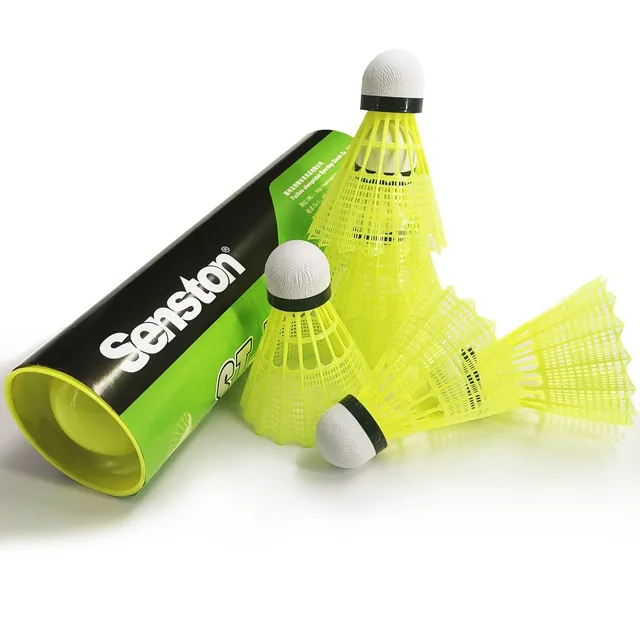
Senston Nylon Shuttlecocks, 6 Pack
Six medium speed nylon shuttles with composite cork heads are the refill for outdoor games where feathers break fast.
Feather shuttles fly differently, and some players will use nothing else. Our Duck Feather Shuttlecocks, 6 Pack come six to a reusable tube, for training and fun. The pack says it outright: they are not for match play. Buyers like the flight and complain about the feathers. One wrote: “The feathers seem brittle, breaking and falling apart in the first rally itself.”
Tip: In cold or dry air, let a little water vapor reach feather shuttles before play. Do not spray hot water on them.
Treat feathers as something you use up. After many games, any shuttle loses its steady flight, and how fast that happens depends on how hard you play.
Can you test shuttle speed at home?
Only on a full court: hit a full underhand stroke from over the back boundary line, and a shuttle of the right speed lands 530 to 990 mm short of the far back line.
“A shuttle of correct speed will land not less than 530 mm and not more than 990 mm short of the other back boundary line as in Diagram B.”
BWF, Laws of Badminton, Law 3
On a short backyard court, the test will not map, because your court is not full length. Try it at a school gym or a sports hall if you have access. The laws even let a member association approve shuttle changes where altitude or climate make the standard shuttle a poor fit. That tells you something useful: air and weather change how a shuttle flies, and nobody expects a backyard bird to behave like one in a hall.
How do you play badminton when it is windy?
A shuttle weighs only 4.74 to 5.50 g, so even a light breeze will push it around, and nylon birds like the ones in our sets cope with outdoor air better than feathers do.
Tip: Set the court so the wind blows along the net, not from one end to the other. If it does blow end to end, swap ends after every game.
Hit flatter and lower in a breeze, since a high shot spends more time in the air for the wind to catch. Keep the feather pack for indoor days. Feathers break faster than nylon, and the flight you buy them for is the first thing a gust takes away. If the wind picks up halfway through, switch to nylon and keep playing instead of chasing a feather across the lawn.

Do you need spare grips and a racket cover?
Yes. The grip is the first thing to wear on a rec racket, and our 4-player set already carries four, while a pack of five Perforated Overgrips with Keel covers the next round.
The grip is the weak spot buyers name most often on our 4-player set. Several wrote that the tape lifted early, and one put it in eight words: “The handle wrapping came off on first use”. The set carries four grips, so you have a fix in the bag.
Tip: Wrap a new grip at the first sign of lifting, before the old tape unwinds in the middle of a rally.
Our perforated overgrips measure 43.3 by 1 inch, five to a pack, keeled or flat, in mixed colors or black. They fit tennis, badminton, squash and pickleball handles. Some buyers find them short on a badminton handle, and one said they are “Not really long enough to 100% cover grip”. If you like a thinner feel, our Racket Grip Tape, 2 Pack is 0.6 mm PU, flat or keeled, in blue or green.
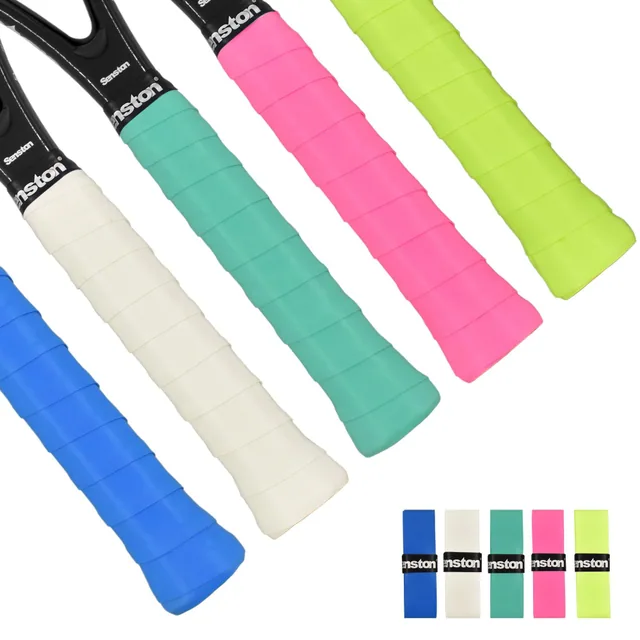
Senston Perforated Overgrips with Keel, 5 Pack
Five perforated overgrips with a raised keel fit badminton and tennis handles and give you a spare for every racket in a set for 4.
You wrap a badminton handle the same way you wrap a tennis one. Our guide to choosing a tennis racket walks through putting on an overgrip step by step, and the method carries straight over. Every grip and tape in our range sits in one place in Grips & Tape.
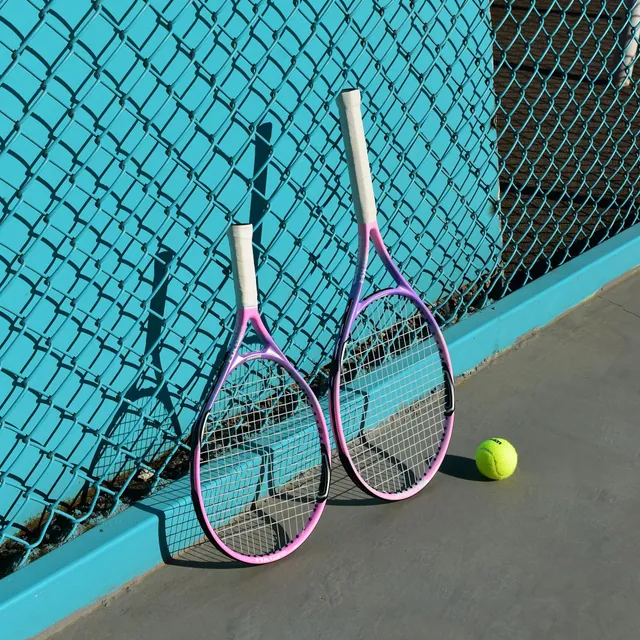
A cover keeps a racket out of the dust between games. Our Badminton Racket Cover is a light zip cover with an adjustable shoulder strap, in black or pink, for carrying one or two rackets to the gym. Buyers give it a mixed record on the strap, and one wrote: “With a day or two of usage strap broke”. If you carry rackets, shoes and shuttles together, our tennis and badminton bag holds five or six badminton rackets.

Senston Badminton Racket Cover
A light zip cover with a shoulder strap keeps one or two badminton rackets clean on the way to the gym.
How much room do you need for a ping pong table at home?
A standard table top is 2.74 m long and 1.525 m wide, so your room has to be longer than 2.74 m by the space you want to stand in at each end. In a 5 m room, that leaves about 1.13 m behind each end line.
“The upper surface of the table, known as the playing surface, shall be rectangular, 2.74m long and 1.525m wide, and shall lie in a horizontal plane 76cm above the floor.”
ITTF, The Laws of Table Tennis, 2.1.1
Do the sum for your own room before you buy a table. Take the length of the room, subtract 2.74 m and split what is left between the two ends. Do the same across the width with 1.525 m. Count the net posts too: the laws put their outer edge 15.25 cm beyond each side line, so the net assembly is wider than the table.
- Table top
- 2.74 by 1.525 m
- Height above the floor
- 76 cm
- Posts beyond each side line
- 15.25 cm
What does a tight room mean for the game? With little space at the ends, you will play close to the table, with short pushes, blocks and quick returns. That is a fine way to learn, and plenty of families play this way in a garage. With more room, players can step back and swing a bigger stroke, and the game opens up. Neither is wrong. Just know which game your room will give you.
The surface matters as much as the size, and the laws give you a test for it.
“The playing surface may be of any material and shall yield a uniform bounce of about 23cm when a standard ball is dropped on to it from a height of 30cm.”
ITTF, The Laws of Table Tennis, 2.1.3
Tip: Hold a ball 30 cm above a homemade top or an old garage table, let it fall, and check that it comes back about 23 cm.
Height is the last check. The laws set the top at 76 cm above the floor. A dining table can host a game, but measure it first so you know how far it sits from that 76 cm. Your kid will learn the same strokes either way, and the numbers simply tell you what you are working with.
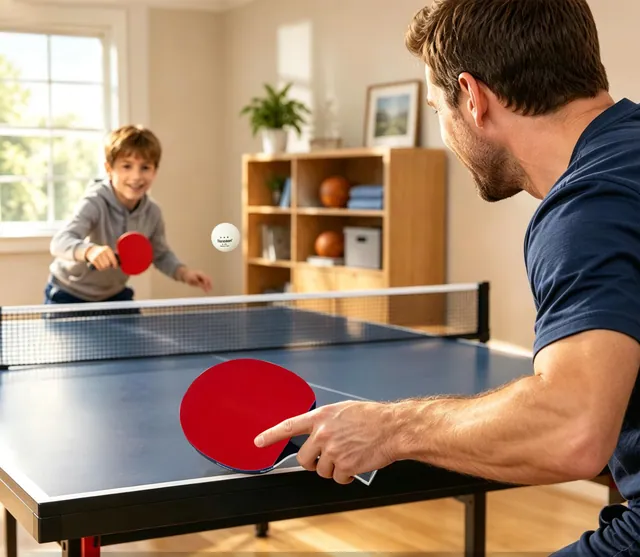
What ball and net do you need for ping pong at home?
Use 40 mm balls that weigh 2.7 g, in white or orange, which is the ball the laws of table tennis describe. Hang the net so its top sits 15.25 cm above the table along its whole length.
- Ball diameter
- 40 mm
- Ball weight
- 2.7 g
- Net height
- 15.25 cm
The laws also ask for a matt ball, made of plastic, and a dark, matt table with white lines along the edges. At home, pick whichever of the two ball colours stands out on your own table. A ball you can track is a ball you can hit.
Balls are the item you will replace most. They crack underfoot, roll under the sofa and vanish into flower beds. Our 5-ply 4-pack comes with six balls and the 2-pack with three, which gets you started. Buy a spare box early, and check that it says 40 mm.
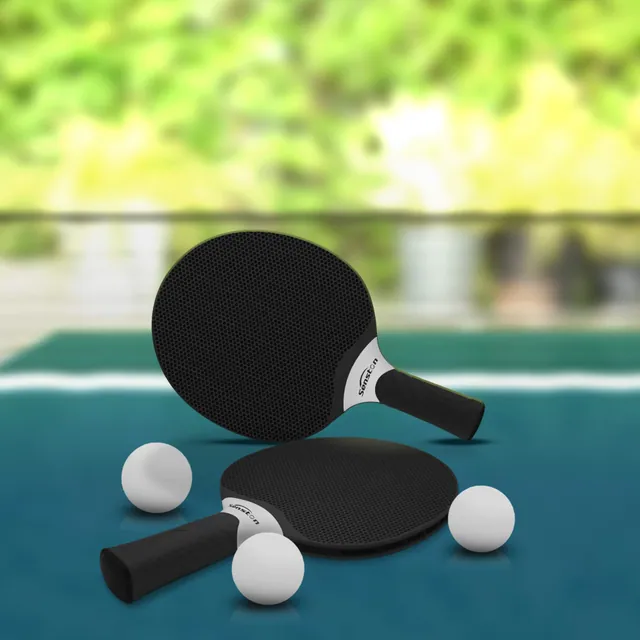
A clip-on net turns a flat table into a ping pong table for an afternoon. One version of our Ping Pong Paddle Set for 2 Players adds a net to two paddles, three balls and a storage bag. Set the top at 15.25 cm if the clamps let you, and pull it tight along the whole length.
Ping pong has one ball size for everyone, from your kid to your grandfather. Other sports change the ball as children grow, and our guide to ball sizes by age covers basketball, soccer, volleyball and football year by year.
5-ply, 7-ply or carbon: which ping pong paddle should you buy?
Start with a 5-ply blade and 2 mm sponge if you are learning, like our 5-Ply Ping Pong Paddles. Move to a 7-ply paddle when you want more speed, and save carbon for advanced players who already control a fast ball.
“At least 85% of the blade by thickness shall be of natural wood”
ITTF, The Laws of Table Tennis, 2.4.2
Every paddle in our table tennis range is a wood blade with rubber on it, and the plies are the layers of that wood. The laws let a glue layer inside the blade carry carbon fibre or glass fibre, as long as it is no thicker than 7.5% of the blade or 0.35 mm, whichever is smaller. That is how a carbon paddle can still be mostly wood. Rubber has a cap as well: sponge plus a pimpled top sheet must stay under 4.05 mm thick, glue included.
- Natural wood in the blade
- at least 85%
- Fibre glue layer
- up to 0.35 mm
- Sponge and rubber
- under 4.05 mm
5-ply with 2 mm sponge
Our 5-ply paddles put a 2 mm sponge under high friction rubber. The 5-Ply Ping Pong Paddles, 4 Pack is for learning spin at home with friends. The 5-Ply Ping Pong Paddles, 2 Pack suits two players who want more spin than basic paddles give, in blue, green, purple or pink and blue.
The Family Ping Pong Paddles, 2 Pack uses a 6.5 mm blade of five ayous wood layers, the same 2 mm sponge and a flared handle. The figures given for this paddle set are speed 8.5, spin 8.5 and control 8.5. Read them as a sign that the set aims for balance over raw pace.

Senston Family Ping Pong Paddles, 2 Pack
A 6.5 mm five-layer ayous blade with 2 mm sponge and a flared handle suits casual home games.

7-ply and thicker sponge
Our 7-Ply Ping Pong Paddles with Case add two layers of wood and a thicker, stickier sponge, with three balls and a nylon case. They are for regular players who want more speed, and we would not hand them to the youngest beginners.
The Pro Ping Pong Paddles, Set of 2 use a 7-layer wood blade with sponge rubber and a fitted case, for players who have moved past basic paddles. Weight is the point buyers argue about. Some like the solid feel, and one wrote: “These paddles are twice the weight of any paddle I’ve ever used.” If your family has small hands or short sessions, start lighter.
Carbon
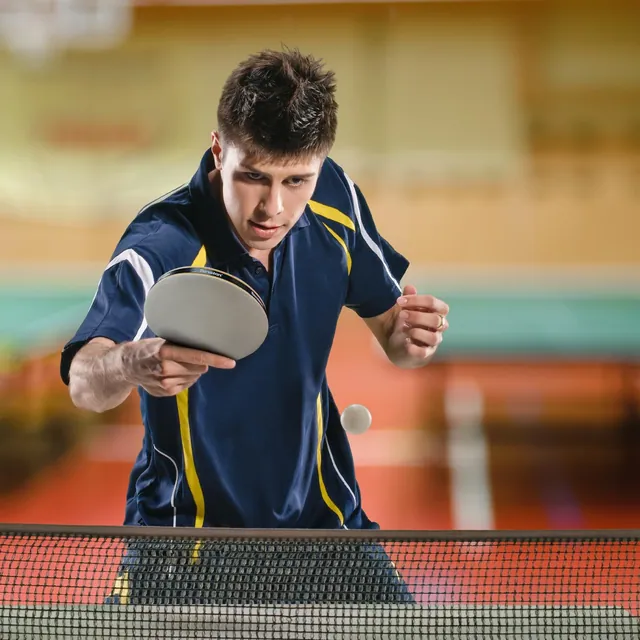
Our Carbon Ping Pong Paddle Set puts carbon fiber layers in a 7-ply board, with rubber on both sides, for faster and harder hitting. Beginners usually control a slower all-wood blade better, so we do not suggest it as a first paddle.
A word on colour. The laws ask for matt rubber, black on one side and a bright colour on the other. Our Colorful Ping Pong Paddles, Set of 4 come in glossy yellow, green, pink and blue, so each player knows which one is theirs. They are made for family game night and school PE, not for serious spin practice or a league match.
| Paddle set | Players | Blade | Sponge or rubber | Suits |
|---|---|---|---|---|
| 5-Ply Ping Pong Paddles, 4 Pack | 4 | 5-ply wood | 2 mm sponge | Learning spin at home with friends |
| 5-Ply Ping Pong Paddles, 2 Pack | 2 | 5-ply wood | 2 mm sponge | Two players who want more spin |
| Family Ping Pong Paddles, 2 Pack | 2 | 6.5 mm, 5 ayous layers | 2 mm sponge | Casual home games |
| 7-Ply Ping Pong Paddles with Case | 2 | 7-ply wood | Thick sponge | Regular players who want more speed |
| Pro Ping Pong Paddles, Set of 2 | 2 | 7-layer wood | Sponge rubber | Players past basic paddles |
Should you buy a 2-player or a 4-player ping pong set?
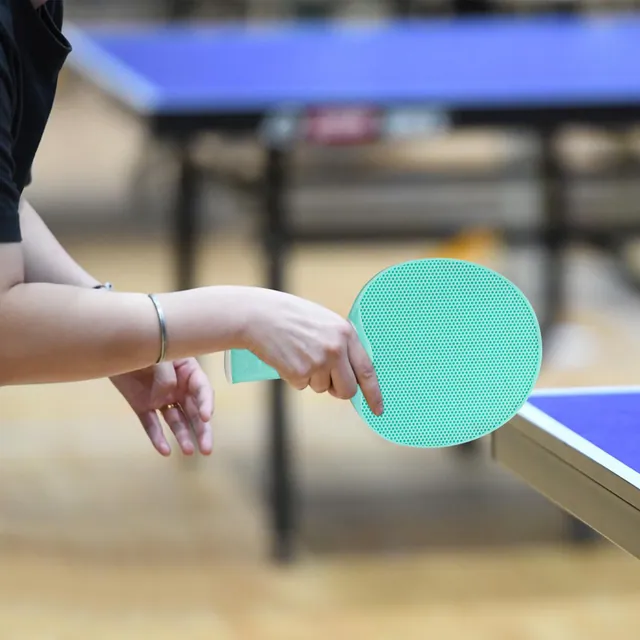
Buy the 5-Ply Ping Pong Paddles, 4 Pack if more than two people use the table: four paddles, six balls and two carry bags. A 2-player set covers a parent and a kid, and the 5-ply 2-pack has two paddles, three balls and one bag.
- 5-ply 4-pack
- 4 paddles, 6 balls, 2 bags
- 5-ply 2-pack
- 2 paddles, 3 balls, 1 bag
Doubles is where the 4-pack earns its place. Four people can play at once, and nobody waits by the wall for a turn. In a small room, though, doubles gets crowded fast, so do the room sum first. If only two of you fit at the table, two paddles are enough.
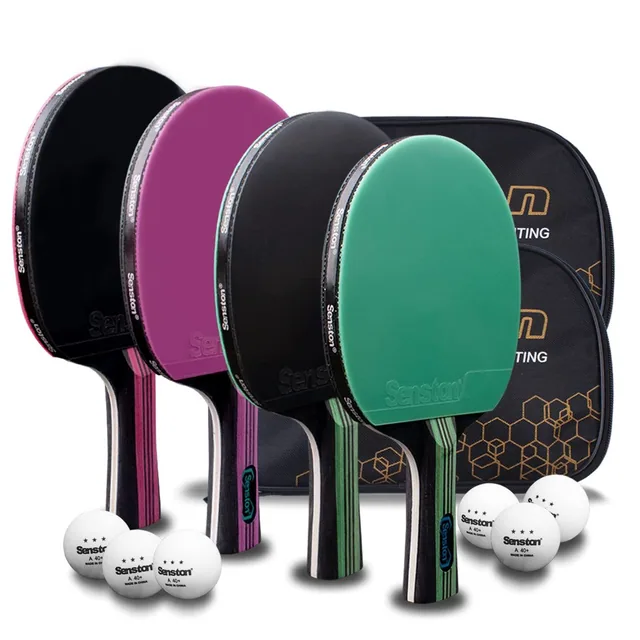
Senston 5-Ply Ping Pong Paddles, 4 Pack
Four 5-ply paddles with 2 mm sponge, six balls and two carry bags set up a family table for doubles.
Our range also has composite rubber sets. The Ping Pong Paddle Set for 4 Players has four paddles with soft, rubber-coated handles, for the basement table where everyone plays. It is not for players who want to choose their own rubbers. The 2-player composite set has two paddles, three balls and a storage bag.
Keep the bags. A paddle that lives in its bag stays clean, and the balls stay with the paddles, not under the sofa. Our 7-ply and Pro sets come with a nylon bag or a fitted case, and both 5-ply packs come with carry bags.
Why do new ping pong paddles smell of rubber?
New 5-ply paddles carry a rubber smell that fades after a few days in a cool room with fresh air. Heat and sun make it stronger, and the 4-pack’s notes suggest airing the paddles for 48 hours before play.
Tip: Open a new box on a porch or in a garage, take the paddles out of their bags, and keep them out of direct sun for the first 48 hours.
Some buyers find it more than slight. One buyer of our 5-ply 2-pack called it a strong chemical odor and planned to send the paddles back. The family 2-pack carries the same note, and anyone sensitive to a rubber smell should think twice about it.
Peeling is the other complaint. A few buyers of the 5-ply paddles report the rubber lifting from the wood within a week or a month. One wrote: “We have played for a week with these and the rubber is already peeling off of their face.” Others say the paddles held up well for them and their kids. It is a mixed record, and you should weigh it before you buy.

When should you buy something other than Senston?
Buy elsewhere if you string rackets above the 28 lb our N80 takes, need tournament shuttles, or glue your own table tennis rubbers. Our rackets and paddles, from the N80 to the 5-ply sets, are made for backyards, garages and family rooms.
- Set for 4 strung at
- 20 to 22 lb
- 76 g racket strung at
- 24 to 26 lb
- N80 restring
- up to 28 lb
Here is who should look past our range:
- Club badminton players who string tight. Our rackets come strung for rec play, and if you need more than 28 lb, buy a racket built for it.
- Strong hitters. One N80 buyer wrote that the strings are “not recommended for players like to play with powerful shots”. If you smash hard every rally, plan on a restring or a frame made for that game.
- Players who need tournament shuttles. Our feather pack is for training and fun, not matches, and our nylon birds are medium speed for yard games.
- Little kids on full-size rackets. Our N80 is the wrong choice for them, and a short junior racket at 58 cm fits them better.
Tip: Your club or league names the shuttle, racket and paddle rules it plays by. Ask before you buy, and shop from that list.
- Table tennis players who build their own paddles. If you pick a blade, choose rubbers and glue them on yourself, our assembled paddles are not what you want.
- League table tennis. The laws ask for matt rubber, black on one side and bright on the other, and your league will tell you which paddles it accepts.
For everyone else, the kit is simple: a net at 1.55 m, light rackets and nylon birds in the yard, and a 2.74 m table with room to step back in the house. You can read more about who we are and what our range is for.
Keep reading: if your family also plays tennis, How to choose a tennis racket covers kids racket lengths from 17 to 25 inches, grip size and how to wrap an overgrip. For basketball, soccer, volleyball and football, Ball sizes by age sets out which ball fits which age.
Sources
- BWF Laws of Badminton, version 5.0 (in force April 26, 2025), read October 28, 2026.
- ITTF Statutes 2026, The Laws of Table Tennis, read October 28, 2026.
Keep reading

Ball Sizes by Age: Basketball, Soccer, Volleyball, Football
Ball sizes by age for basketball, soccer, volleyball and football, from the youth rule books, and which Senston ball fits a kid, a teen or an adult.
Read the article
How to Choose a Tennis Racket for a Kid or an Adult
Racket length by age from 17 to 27 inches, the 4 1/4 inch grip, overgrips and how to wrap one, dampeners, covers, bags and beach tennis paddles.
Read the article